How the Queen Chess Piece Moves, Captures and Stays Safe
Learn how the queen chess piece moves and captures, what its nine-point value means, and how to review queen-safety mistakes after a game.
- Piece Movement
- Material Value
- Piece Safety
On this page
White queen chess piece: d1 (light square)
Black queen: d8 (dark square)
The queen is a tall piece with a crown. There are differences between chess sets in terms of what the queen looks like, usually only slightly.
In general, the queen is second-tallest after the king, and she has a crown with multiple points or bumps. She usually sits on the light square d1 for White, and dark square d8 for Black. The queen’s starting placement is beside the king, regardless of the set’s design.
A queen can move along any straight line to any number of squares, just like the rook, but also diagonally, just like the bishop. That means that the queen can capture by landing on an enemy piece’s square, but not jumping over intervening pieces.
Queen movement
The queen moves straight along a rank (row), file (column) or diagonal. Unlike the knight, which moves in an L-shape and can leap over other pieces, the queen must travel along a clear path to her destination, and cannot jump over intervening pieces.
She moves from her starting position on the d-file — either d1 or d8, depending on your color — toward any of the ranks, files or diagonals you choose. Let’s say, for instance, that the queen starts at d4. If the squares e5, f6 and g7 are unoccupied, then the queen can move to g7. However, if there is a piece on e5, the queen cannot move beyond it, as there’s no way to “jump” over that square. She can capture an enemy piece on e5, but cannot land there if it’s one of her own pieces. And, obviously, if there’s an enemy on g7, then that is where the queen must land to capture that piece.
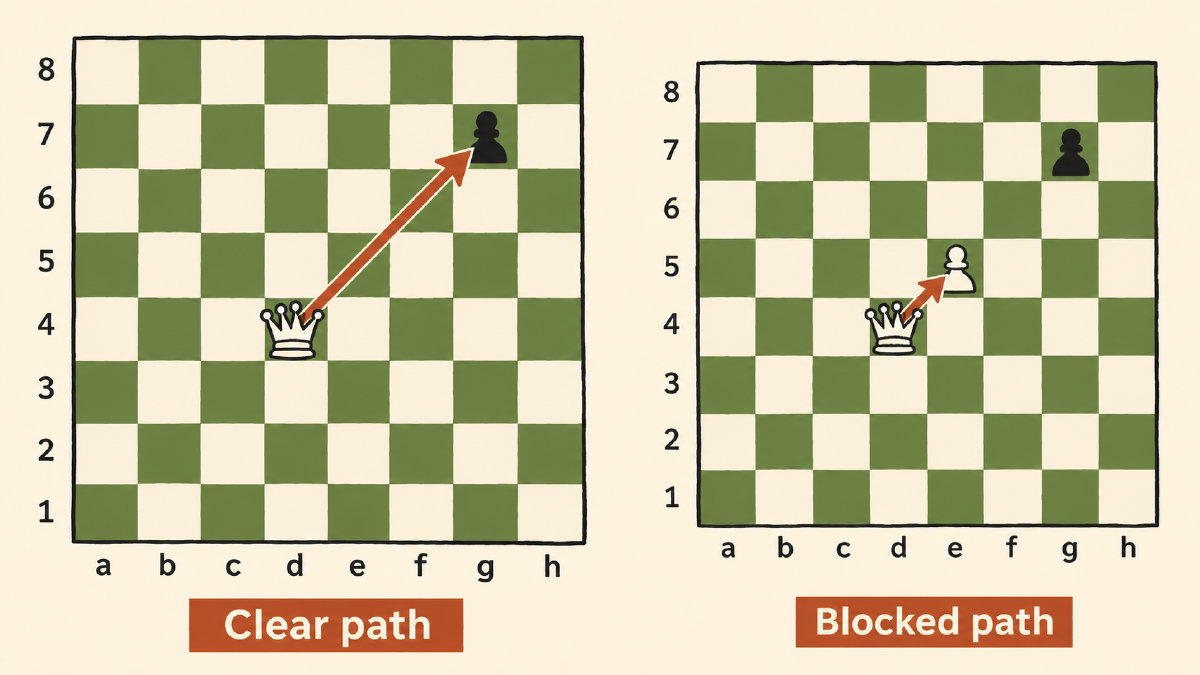
You can also think about it in geometric terms. The squares along any given straight movement line form part of a rank, file or diagonal. This geometry helps you understand how a queen travels and attacks.
It’s important to note that the queen doesn’t necessarily need to move to the farthest square possible. For example, a queen might be able to capture an enemy pawn on e5. But if the e5 pawn was attacked by another of your pawns, or protected by one of your knights, then it might not make sense to move your queen to e5 unless you’re sacrificing her to capture the enemy pawn.
Queens are valuable pieces
When exchanging pieces with opponents, the queen is generally considered to be worth approximately nine pawns. In some situations, she can be worth slightly more than a rook and bishop combined; others might consider her slightly weaker than two rooks.
But these are approximate values. It’s rare that material comparisons alone determine whether a particular exchange is favorable. A deliberate trade of a queen for a lesser opponent piece (like a knight) can actually be advantageous if the resulting position gives your pieces greater mobility.
That said, queen exchanges can happen at different stages of the game, so it’s usually a bad idea to trade them away unless you’re sure you’ll gain more in return.
Pawns can be promoted to queens
One unique rule is that both players get to promote their pawns into queens when they reach the player’s farthest rank (the eighth rank for White, and the first rank for Black). Pawn promotion can even give a player an additional queen or replace a lost one! Each player starts with one queen, though, so it won’t be common to see multiple queens on the board.
Promotion choices include a queen, rook, bishop or knight, so each promotion decision involves some trade-off. Should you convert your last pawn into a queen or a rook? Do you want a queen or a bishop, and why?
Developing the queen too early can cost time
An attacking piece can take advantage of the fact that the queen is exposed, but repeated attacks on the queen may be a sign of poor play. Usually, the attacker would develop his pieces to threaten the queen, which would prompt the queen to escape.
However, early queen development is sometimes used in the opening by high-level players, who know that their opponent might be developing his pieces quickly enough to challenge their queen. Early queen-led attacks are unusual, though, in high-level games.
Reviewing your queen’s safety
Before reviewing your queen’s safety, use the game import or PGN input described on the site’s homepage to load your completed game for browser-based Stockfish review. You can also load a FEN or PGN on the analysis board, move pieces and look at Stockfish’s lines.
After the game ends, try to find out what happened before the queen came under attack or was captured. Was there a route the attacker could’ve taken? Were there blockers in the way? What did your opponent reply with?
If you can find a candidate alternative, then trace the attacker’s route again. How many squares were available for attack? Did the attacker sacrifice something to do it? Can you spot a pattern?
You can record one concrete checking habit you’d like to implement next time you play: Checking if the queen’s being attacked or threatened by enemies before you choose your next move.
Sources
More in Chess Basics
- How Fools Checkmate Works and How to Avoid ItUnderstand fools checkmate, usually called Fool's Mate: the two-move sequence, why White cannot escape, and pawn mistakes to review afterward.
- How to Use Chess Piece Points to Count Material and Compare TradesLearn chess piece points, count material after exchanges, and understand why activity, king safety and engine evaluations can outweigh the totals.
- How the Horse Chess Piece Moves, Jumps and CapturesThe horse chess piece is the knight. Learn its L-shaped moves, how jumping and captures work, and how to recognize a knight fork.