How the Pawn Chess Piece Moves, Captures and Promotes
Learn how the pawn chess piece moves, captures and promotes, what its one-point value means, and what to check after a completed game.
- Piece Movement
- Pawn Play
- Pawn Promotion
On this page
In the game of chess, each side has eight pawns, with the White pawns starting at a2–h2 and moving toward the higher-numbered ranks, while the Black pawns start at a7–h7 and move forward toward the lower-numbered ranks. Pawns can move one square ahead into an empty square, or two squares on their first move, provided that both squares are empty. However, any piece immediately ahead blocks the pawn’s forward movement.
White pawn e4; Black pawn e5: blocked advance
How Pawns Capture
A pawn normally moves straight ahead in a single file, but it can also capture an opponent’s piece by moving diagonally to an adjacent square, as long as the destination square is occupied by an enemy piece. For example, a white pawn at e4 attacks the squares d5 and f5, which are diagonally adjacent to the e4 square. If there’s an enemy pawn at either of these squares, the attacking pawn can take the opponent’s piece. Similarly, a black pawn at e5 attacks d4 and f4, which would be captured if they were occupied by enemy pieces.
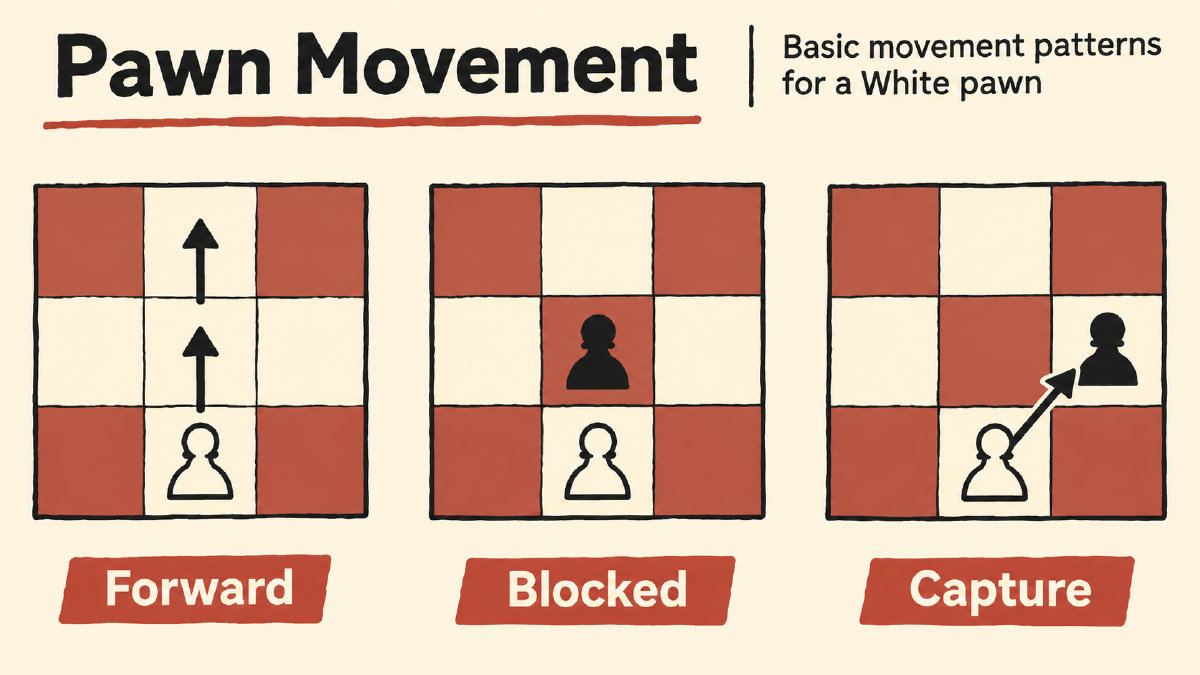
Enemy pawn e5: no forward capture from e4; Black pawn e5: attacks d4 and f4
En Passant
A pawn normally captures an enemy piece on the square it moves to. The only exception is en passant, where a pawn may capture an opponent’s pawn that advanced two squares on its initial move, passing over a square that could have been attacked by a diagonal attack.
Black c7-c5: two-square advance through c6; White pawn initially b5 or d5: attacks c6; Immediate next move only; White b5xc6 or d5xc6 en passant; Capturing pawn lands on c6; Black pawn on c5 removed
Pawn Promotion and Underpromotion
When you promote a pawn, you replace it on the same move with a queen, rook, bishop or knight. You’re allowed another queen for the same color (whether or not any queens have been captured), since this replacement doesn’t violate the rules of material. In fact, you may prefer an underpromotion, such as promoting to a knight, which might check your opponent’s king, or avoiding stalemate.
White: eighth rank; Black: first rank; Replacement on the same move; Same-color queen, rook, bishop or knight; Choice independent of previously captured pieces; Another queen permitted; Knight check: possible tactical reason for underpromotion; Avoiding stalemate: possible reason for underpromotion
Pawn Value and Promotion Potential
Pawns are traditionally worth one point. A conventional position evaluation compares exchanges using the value of different pieces — usually the queen at nine points, rook at five, bishop and knight at three, and so on. However, the position-dependent exchange doesn’t always reflect how many points a particular group of pawns are worth, because promotion potential adds to the value of a pawn.
Pawn: one point; Material comparison guideline; incomplete position evaluation; Three pawns: equal to or stronger than a knight or bishop in some positions; Promotion potential beyond initial material count
Reviewing Pawn Moves With Stockfish
If I’m reviewing a completed game, I’ll paste the PGN into the site’s analysis board, entering either the FEN or the PGN directly into the input box. Stockfish will provide my assistance here. I’ll look before and after a particular pawn move, asking questions like: Did the placement change any of the protected squares or pieces? Was there any protection changed due to the new placement? Does this placement restrict or direct the movement of another piece? And so on. Changing the protection of a square or restricting a piece’s movement alone is not sufficient proof that a player made a mistake.
Completed game’s PGN pasted into the site’s analysis board; Analysis board: FEN or PGN input; Stockfish available; Before-and-after positions around a pawn move; White pawn e4: d5 and f5 attack squares; Previously protected squares or pieces; Pawn placement restricts and directs piece movement; Changed protection or restricted movement alone: insufficient proof of a mistake
Sources
More in Chess Basics
- How the King Chess Piece Moves and Captures SafelyLearn how the king chess piece moves and captures, which squares are unsafe, and how to review check and king-safety mistakes in completed games.
- How to Castle in Chess: Kingside and Queenside RulesLearn how to castle in chess for White and Black, where the king and rook go, and how to check blocked squares, lost rights and check.
- How En Passant Chess Captures WorkLearn en passant chess rules with White and Black examples, the immediate-reply requirement, and king-safety checks for completed-game review.