How the King Chess Piece Moves and Captures Safely
Learn how the king chess piece moves and captures, which squares are unsafe, and how to review check and king-safety mistakes in completed games.
- Chess Rules
- King Safety
- Game Review
On this page
The king is one of the most well-known pieces in chess. It appears as a stylized cross, or some other design, on its piece. The traditional white king starts on e1 and the black king on e8. In English notation, we refer to it as K. You can find other designs for each set, though the Staunton style dominates in tournament play. Other sets may vary from these basic designs.
Ordinary movement
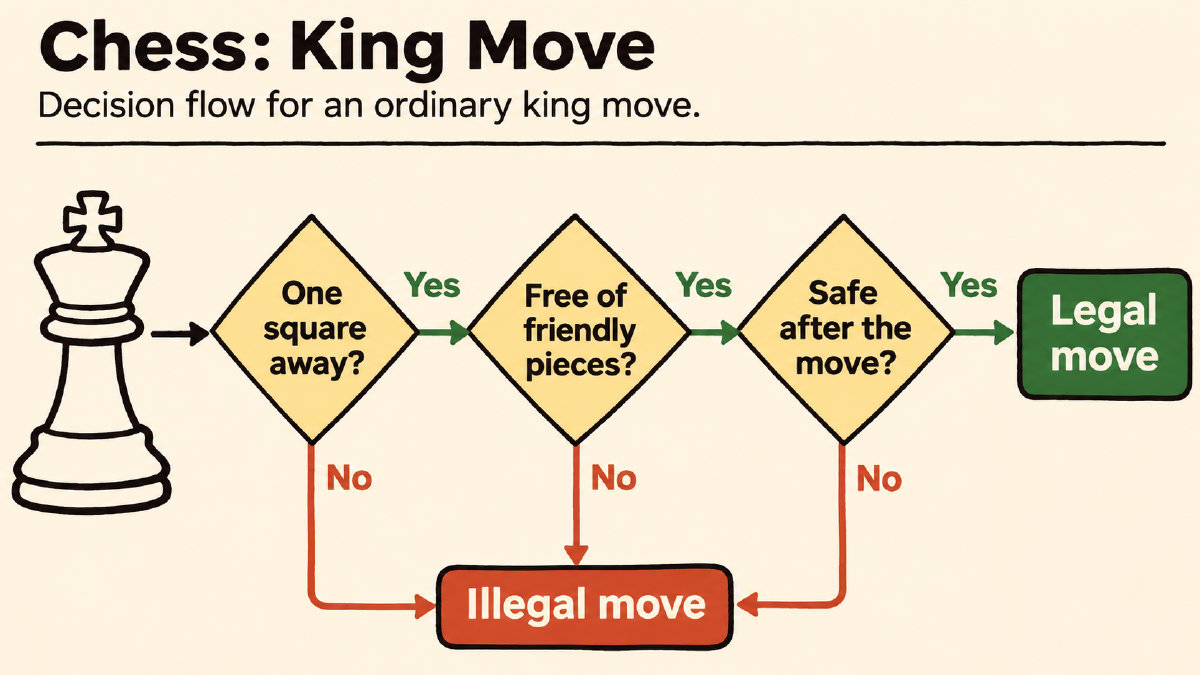
Each king can move either one square horizontally, vertically, or diagonally. A king can reach eight neighboring candidate squares, but only if they are unoccupied by friendly pieces and not attacked by the enemy. If you place a king on the central square of the board (d4), he attacks all eight neighboring squares, while also being able to reach those same squares. When you move a king to a new square, that new square must be free of friendly occupancy — but the king itself can never be captured! So the question is: Is the king safe after this move? This applies to both players; kings can’t capture each other because they’re both attacking adjacent squares. They’ll never be adjacent to each other!
Capturing safely
There’s White Ke1 and Black Ka8 with an additional Black Bf2. All other squares are empty. It’s White’s turn. How does White move?
The obvious move would be to capture the bishop, removing the threat against the king. That seems legal, right? Yes, it’s legal! The bishop is undefended, and capturing it leaves the king safe on f2. In fact, when constructing your own examples, remember that capturing an attacker removes its threat, but a different piece may still attack the king.
Now add a black rook on h2 to the starting position, and capturing the bishop becomes unsafe. The rook is now on h2 and can attack the f2 square through the g2 square. But since the king has moved, the bishop has been removed. Does that affect anything? No, because the rook can attack the king directly.
Responding to check
The immediate response to a check is that the king is under attack. What are the options to respond to a check? The three responses are:
A safe king move
Capture the attacking piece, thereby removing the check
Interpose a piece between the attacker and the king
A block works against a queen, rook or bishop check, but only when there’s an empty square between the attacker and king.
Finding a safe square
But wait: How do I know which move is safe? Let’s say the king is under attack and you want to move him. The king must have a destination square that is not occupied by your pieces and cannot be attacked by the enemy.
Let’s say the king is in the center of the board. Each move requires checking whether the king is in check. For example, suppose that there is a queen threatening my king, but I can move the king to a safe square. That’s fine. But suppose that instead there’s a rook on the third rank, and that I’m trying to move my king to d3, but there’s another rook on c3 that’s attacking me. Then I need to see what happens to the rest of the board after I make that move.
Checkmate and stalemate
That said, there are times when moving the king isn’t possible. Checkmate occurs when a player has his king in check with no legal move available. On the other hand, a stalemate is when a player to move has no legal move, yet their king isn’t in check. Checkmate results in loss; stalemate ends the game in a draw.
Castling is a special case, allowing the king to move two squares horizontally toward a rook, with that rook moving to the square the king crossed. Castling is allowed when neither the king nor the rook have moved yet. Additionally, all the squares between the king and rook must be unoccupied. Castling is not allowed out of, through or into check.
Practice checking legal moves
You can practice identifying the attacker and determining whether a particular move is legal before exploring legal alternatives. One option is to construct a comparison position where you attempt to capture a piece, then see how the king’s safety changes. You can complete the setup using a board editor or by copying the FEN and pasting it to your analysis board. Stockfish analysis is also available.
Sources
More in Chess Basics
- How to Castle in Chess: Kingside and Queenside RulesLearn how to castle in chess for White and Black, where the king and rook go, and how to check blocked squares, lost rights and check.
- How En Passant Chess Captures WorkLearn en passant chess rules with White and Black examples, the immediate-reply requirement, and king-safety checks for completed-game review.
- How to Recognize and Avoid Stalemate in ChessRecognize stalemate in chess, distinguish it from checkmate, and review your completed game's ending to spot how the draw happened.