How to Recognize and Avoid Stalemate in Chess
Recognize stalemate in chess, distinguish it from checkmate, and review your completed game's ending to spot how the draw happened.
- Chess Rules
- Endgames
- Draws
On this page
Stalemate in chess is a conditional draw that doesn’t depend on how much material each side has. The king isn’t in check, and the player whose turn it is doesn’t have any legal moves left.
It’s a very strange concept, since it seems to imply that there are certain positions where you’ve won by default. But it doesn’t work like that: it just means that there are no more legal moves available for the side that has to move.
But then again, that could be considered a victory too. For example, suppose that it’s your opponent’s turn, their king isn’t in check, and neither their king nor any other piece or pawn has a legal move. Then both sides would end up drawing because of stalemate.
So why do we need this conditional rule? It’s because if you can trap your opponent without check, but they don’t have any other squares or pieces to use, then you’re effectively “winning” them over. But it’s only a draw, not a win.
In the first place, it makes sense to understand how to recognize stalemate from checkmate. And in doing so, you’ll discover what happens when neither of those conditions are met — and why they can’t both apply.
A conceptual test
Let’s assume that you’re playing white. That means that you get to move first. In that situation, if the black king was in check (attacked), but had no possible escape, you’d call it checkmate instead of stalemate.
Now suppose that you were to make a move that would trap the black king without check. If the resulting position didn’t have any legal move left, then the game would end in stalemate, not checkmate.
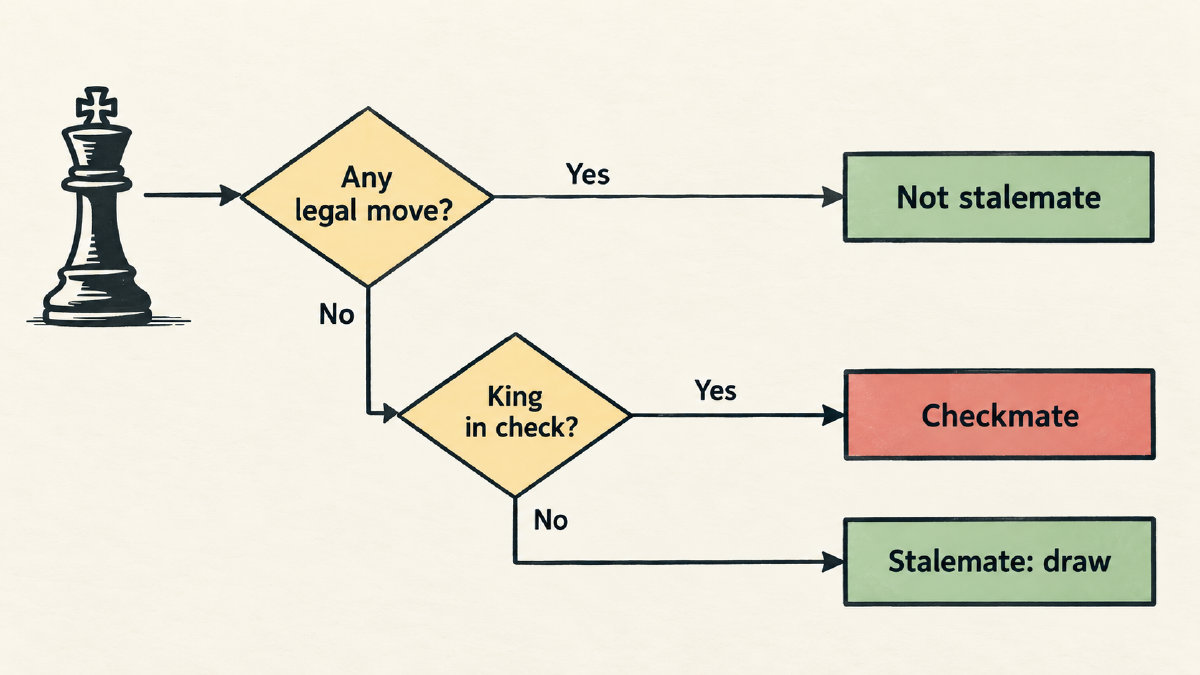
This is the difference between checkmate and stalemate: if it’s your opponent’s turn, their king isn’t attacked, and none of their pieces or pawns has a legal move, then it’s stalemate. If it is attacked, and there are no legal responses, then it’s checkmate.
Of course, the opposite applies as well. Let’s suppose that the black king wasn’t being attacked, but it did have at least one possible legal move remaining. Then it wouldn’t be stalemate. If it had some kind of square that allowed it to move away, then it still wouldn’t be stalemate either.
You might think that there’s a problem with all of these scenarios. After all, you could avoid causing stalemate by leaving your opponent at least one legal move. And in many situations, you could even prevent it completely by taking care to keep the king safe!
The same principle also applies here: remaining material can hide a complete lack of legal moves. For example, you could find yourself with pawns, rooks and knights blocking their own movement, yet not being able to attack the king.
What about bishops who are pinned to their own king? What about kings that aren’t safe even after a proposed move?
That’s where the danger really lies. At least one opposing piece or pawn, including the king, must have a legal move to avoid stalemate when the king isn’t in check. The others can remain blocked.
A prevention habit
One good habit to get into is to examine the resulting position before restricting the opposing king. This allows you to determine whether the opposing king is safe, and whether any legal move remains.
For example, if you move without checking, you need at least one opposing legal move to prevent a stalemate. That could be a simple pawn move or minor-piece move, but perhaps not. In some cases, it may even involve making a strong move against the king itself.
If you make an aggressive restriction that removes the last legal option, then the game ends in stalemate. Or maybe it ends in checkmate. If you can’t see the result of your proposed move, then you need to take a step back and reconsider.
Alternatively, you can choose to make a checking move, and see whether it leads to checkmate. If it does, then the resulting position is checkmate. If not, then you need to rethink your strategy.
Stalemate as a conditional defensive resource
Stalemate is a condition that you can rely on in some situations. It may not be something you expect to happen during a regular match, but you never know. It’s always better to play conservatively than to risk losing everything.
In fact, if you fall behind, stalemate can actually help you out. Why? Because you may be able to force a stalemate by inviting an opponent to make a mistake.
But success depends on what you do next, regardless of whether you succeed in stalemating your opponent. You can use it to defend your advantage, or to force a draw instead of a defeat.
It’s not uncommon for kings to be placed in corners. Sometimes they can be safely protected by another pawn, sometimes they’re forced back by an opponent’s pawn. Either way, you should be careful about placing the king where it’s vulnerable.
And that brings me to my final point: it’s important to consider the resulting position. When trying to decide whether a stalemate is inevitable, ask yourself: is the king in check? Are there any legal moves remaining?
If the answer to both questions is yes, then it’s not a stalemate. If the answer to the second question is no, then it’s stalemate if the king isn’t in check, or checkmate if it is. If any legal move remains, then it’s not a stalemate. You can review a finished game in ChessAnalysis by importing it from Chess.com or Lichess, or pasting its PGN. Or you can paste a FEN into the analysis board, or set up the position in the board editor. Confirm whose turn it is; the editor lets you select this. Then check whether that king is attacked and look for legal moves by every piece and pawn. Compare the positions before and after the last move: which options disappeared? Try alternative moves on the analysis board. Leaving a legal move avoids stalemate, but does your alternative keep the winning chances? You can use the editor’s Stockfish analysis to check that too.
More in Chess Basics
- How to Choose Great Opening Moves in Chess as a BeginnerChoose great opening moves in chess with 1.e4 or 1.d4, purposeful development and king safety, then review those decisions in completed games.
- How to Recognize Zugzwang in Chess EndgamesRecognize zugzwang with a king-and-pawn example, understand why whose turn it is matters, and learn what to check in completed-game reviews.
- How to Recognize and Prevent Scholar's MateRecognize Scholar's Mate, understand the queen-and-bishop attack on f7, and review the defensive moves that stop the four-move checkmate.