How to Choose Great Opening Moves in Chess as a Beginner
Choose great opening moves in chess with 1.e4 or 1.d4, purposeful development and king safety, then review those decisions in completed games.
- Opening Principles
- Game Review
- King Safety
On this page
There are many things that beginners need to learn about chess. But one of the most important is how to choose great opening moves.
When I was just starting out, I thought that memorizing openings would help me become a better player. I learned a few opening lines and played them over and over again, but never really understood why those particular moves were good. And then, when I started playing against people who knew what they were doing, I found that my memorized lines didn’t work very well for me at all.
So now that I’ve been playing for more than a decade, I can say with certainty that it’s much more important to understand the underlying principles behind each move than it is to memorize any particular sequence of moves.
In this article, we’ll take a look at several basic principles that will help you choose great opening moves.
Central Influence
One of the most important things you can do on your first move is to control the center. The two main ways to do this are 1.e4 and 1.d4. Both of these moves give you central influence by controlling the squares d5 and f5 (for 1.e4) or c5 and e5 (for 1.d4).
But there’s another reason why both of these moves are so effective. Each of them also opens up new lines for your queen and bishop to attack through. That’s something you might not realize at first, but if you’re trying to develop your pieces quickly, then you want to be able to get your queen and bishop into action early.
For example, after 1.d4, you have a pawn on d4, which controls c5 and e5. Then your knight on c3 can jump to b5 and support that pawn. Your bishop on g2 can control d5 once its diagonal is clear. And your queen can come to d5 to threaten the pawn on e5.
Now let’s compare that to the position after 1.e4. After 1.e4, you have a pawn on e4, which controls d5 and f5. Your knight on f3 can jump to g5 and support that pawn. Your bishop on g2 can control d5 once its diagonal is clear. And your queen can come to d5 to threaten the pawn on e5.
Both of these positions give you an opportunity to develop your queen and bishop quickly.
Development
Another thing to consider when choosing your opening moves is development. Development means giving your knights and bishops useful jobs to do. For example, the knight on f3 isn’t just sitting around waiting to be developed; it’s actively attacking the square e5. If Black doesn’t respond properly, he could lose his pawn on e5.
The bishop on c4 is also doing something useful. It’s attacking the pawn on f7, and it’s helping prepare for castling kingside.
Let’s take a look at an example of this in action. Here’s the Italian Game:
1.e4 e5
2.Nf3 Nc6
3.Bc4
After 1.e4 e5 2.Nf3, White has a pawn on e4 and a knight on f3, attacking Black’s pawn on e5.
After 1.e4 e5 2.Nf3, the knight on f3 attacks the pawn on e5. If Black doesn’t defend or support that pawn, it could be lost. After 2.Nf3, the knight on f3 is fully developed and ready to attack the pawn on e5.
Black’s best response is usually to play 2…Nc6, supporting the pawn on e5. Now the knight on f3 is fully developed and ready to attack the pawn on e5.
White’s next move is often 3.Bc4, developing the bishop while attacking the pawn on f7. This puts pressure on the pawn on f7, and prepares for castling kingside.
Occupation of the Center
Another important factor in choosing your opening moves is occupation of the center. This refers to having pawns in the center of the board, which gives you greater control over the center. The more central pawns you have, the more space you’ll have for your other pieces.
But you don’t want to occupy the center too soon. In fact, it’s often better to leave the center open for now so that you can focus on developing your pieces. Let’s see how this works in practice.
In the Scandinavian Defense, White plays 1.e4, and Black responds with 1…d5. Black is occupying the center with his pawn on d5, while challenging White’s pawn on e4. Let’s see why.
After 1.e4, White has a pawn on e4, which controls d5 and f5. After 1…d5, Black has a pawn on d5, which controls c4 and e4. So Black is occupying the center and challenging White’s pawn on e4, while White’s pawn still controls d5 and f5.
This is why it’s often better to leave the center open for now. You can always occupy the center later once you’ve developed your pieces. As Black, you can also occupy the center with 1…e5 against 1.e4, challenge it immediately with 1…d5, or develop your pieces and contest it later. In the Scandinavian, play can continue 2.exd5 Qxd5 3.Nc3. White develops a knight while attacking Black’s queen, so Black has to spend another move dealing with that attack.
King Safety
Another thing to consider when choosing your opening moves is king safety. Castling is the purpose of the king moving away from the center. When you castle, you’re giving your rooks a chance to activate themselves, and you’re helping connect your rooks.
Castling also helps protect your king. If you castle kingside, you’re giving your rook a chance to protect your king. If you castle queenside, you’re giving your rook a chance to protect your king.
However, there are times when you might want to delay castling. Sometimes you’ll find that it’s better to keep your king in the center for a while longer. Or you may find that you’re under immediate threat of attack on the side where you intend to castle, so it’s better to keep your king in the center for now.
Also, sometimes it’s better to keep your king in the center temporarily because you have an immediate tactical threat that needs to be answered before you castle.
Material Gains
Sometimes, the best way to make progress in the game is to win material. If you can capture a piece right away, that’s obviously going to give you a big advantage. But even if you can’t capture a piece immediately, you should still look for opportunities to gain material.
It’s easy to overlook small advantages, but they can add up quickly. For example, if you can win a pawn early in the game, you may gain an advantage, but you still need to watch your development and king safety. And if you can win a knight, that’s even better.
Checking Forcing Possibilities
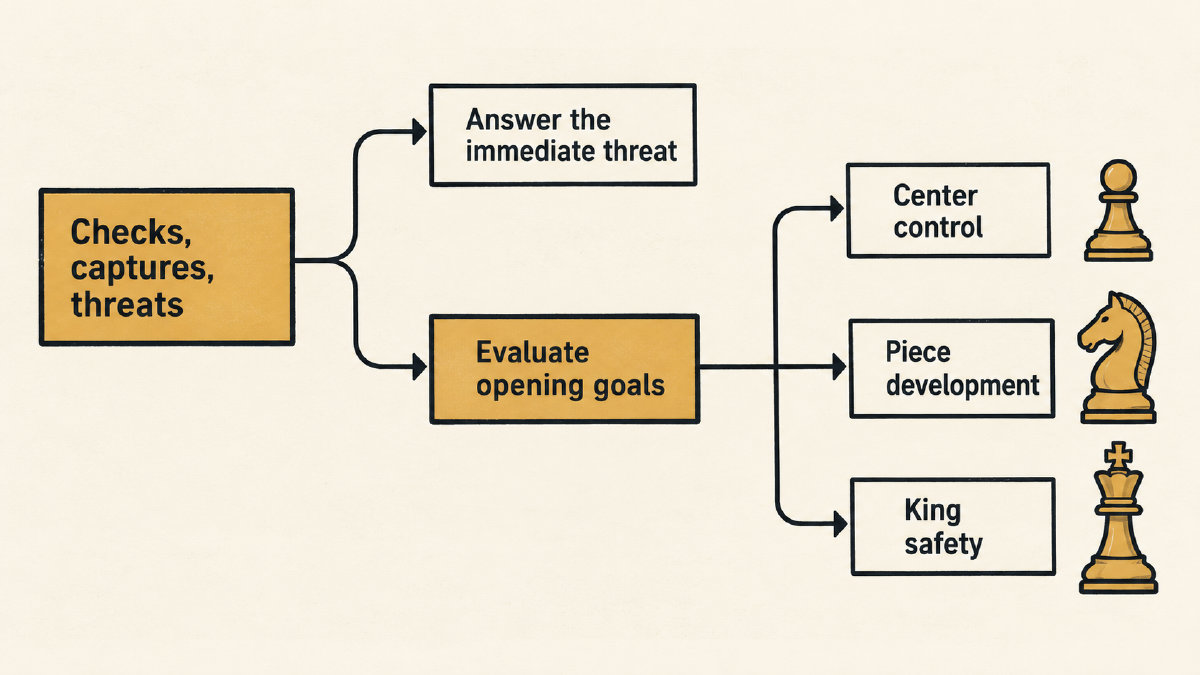
Before you start developing your pieces normally, you should check to see if either player has any forcing possibilities. Forcing possibilities are checks, captures, and threats that force the opponent to respond. These kinds of moves can lead to a quick win or a decisive advantage.
You should check for forcing possibilities for both players. If you find that the opponent has an attacked piece that requires another move, you should consider that possibility. Also, if you find that you have an opportunity to win material, that’s another possibility to consider.
Finally, you should look for any opportunity to create a forcing threat. A forcing threat is a move that forces the opponent to respond. These kinds of threats are often created by sound theoretical variations, or by changed positions.
If you find that you have a forcing threat, that’s a good indication that you should stop developing your pieces normally and look for other options.
Time Lost Through Unnecessary Repeat Moves
It’s easy to waste time by repeating the same move over and over again. This is especially true in the opening. There are a lot of possible moves to make in the opening, so it’s easy to get stuck in a loop of making the same move again and again.
You can avoid wasting time like this by learning the different types of moves that are available to you. There are a lot of different types of moves, including checks, captures, and threats. If you know the difference between these types of moves, you’ll be able to avoid wasting time by repeating the same move over and over again. But moving the same piece twice can be necessary if it’s attacked, or worthwhile if you’ve calculated a tactical opportunity. Check those possibilities before deciding to develop another piece.
Queen Exposure
It’s also easy to waste time by exposing your queen too early in the game. You should only expose your queen if you have a concrete reason to do so. Otherwise, it’s better to keep your queen safe in the back ranks until you’re ready to use her.
Tactical Sequence Takes Priority Over Normal Development
Sometimes, it’s better to ignore normal development and focus on a tactical sequence that takes priority over normal development. Tactical sequences are moves that are based on concrete threats, rather than general strategic ideas.
Tactical sequences are often short, so they’re easy to remember. They’re also fun to play, which makes them ideal for beginners. However, you shouldn’t rely on them too heavily, since they can be dangerous if you’re not careful.
Study of the Unfamiliar Decision
Finally, you should study the unfamiliar decision over long memorized sequences. It’s easy to fall into the trap of relying on memorized sequences, especially if you’re just starting out. But the more you study unfamiliar decisions, the more likely you are to make good decisions in the future.
To study unfamiliar decisions, you can use a variety of methods. One method is to import a finished game from Chess.com or Lichess, and then use the ChessAnalysis browser-based Stockfish review of every move to determine the accuracy, blunders, and best move.
You can also use the 365Chess Analysis Board to analyze games and see exactly where mistakes were made. The ChessAnalysis analysis board lets you move pieces, input FEN or PGN, and see the Stockfish best lines.
I recommend studying the first position where you no longer knew what to do manually. Once you’ve identified the strategic ideas, you can turn to the engine to confirm or deny your assessment.
Sources
More in Chess Basics
- How to Recognize Zugzwang in Chess EndgamesRecognize zugzwang with a king-and-pawn example, understand why whose turn it is matters, and learn what to check in completed-game reviews.
- How to Recognize and Prevent Scholar's MateRecognize Scholar's Mate, understand the queen-and-bishop attack on f7, and review the defensive moves that stop the four-move checkmate.
- How the Bishop Chess Piece Moves and CapturesLearn how the bishop chess piece moves and captures, why blocked diagonals matter, and how its three-point value depends on the position.