How to Recognize and Prevent Scholar's Mate
Recognize Scholar's Mate, understand the queen-and-bishop attack on f7, and review the defensive moves that stop the four-move checkmate.
- Checkmate Patterns
- King Safety
On this page
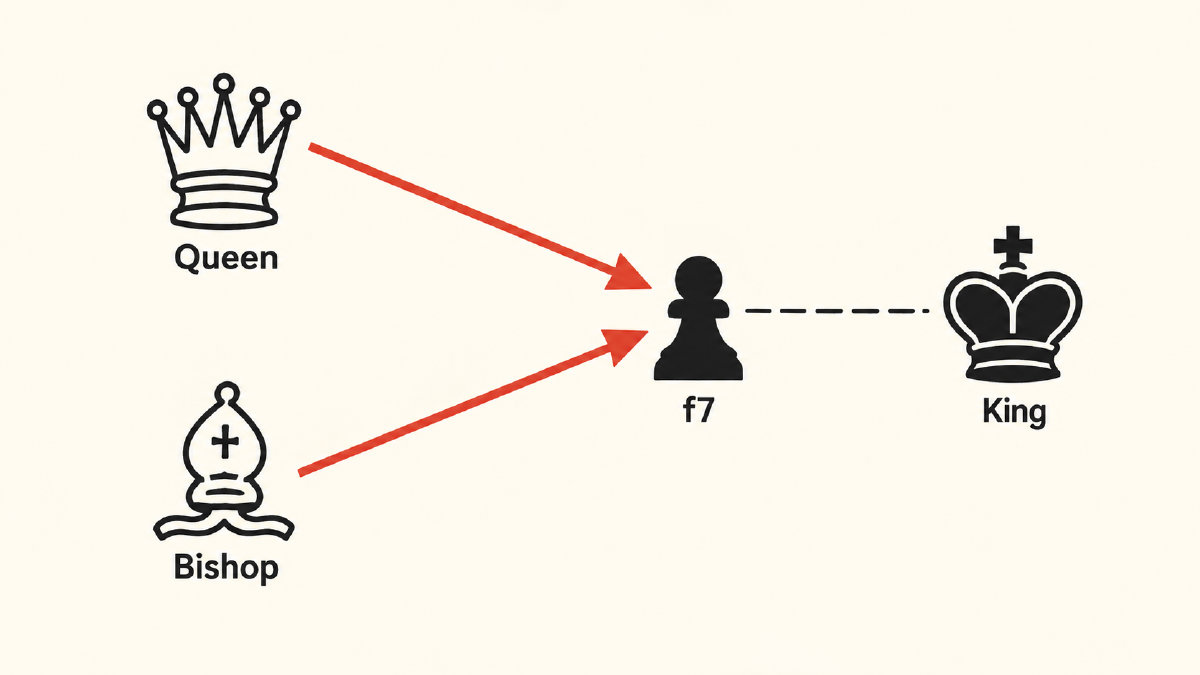
White’s opening move is e4, the first step toward a variety of openings. If Black responds with 1...e5, White might continue with Bc4, setting up an attack against f7. After 2.Bc4, Black can prevent this setup with 2...Nf6; after 2...Nc6, White can add to the attack with 3.Qh5. After 2...Nc6 3.Qh5, the result is a powerful mating threat that can be countered by either moving the g-pawn to g6 or the queen to f6. Playing 3...Nf6 instead allows 4.Qxf7#. But if you play too late, it won’t matter. Scholar’s Mate is commonly called the four-move checkmate, though other four-move mates exist. Fool’s Mate is the fastest possible checkmate, taking just two moves.
The bishop-first variation of Scholar’s Mate (the most common way to achieve this) has been played in recorded games for centuries. In one case, the queen was sacrificed immediately on move two to prevent this checkmate. The key is recognizing when and how you’re being attacked, then playing the best move available to counter.
Queen-first and bishop-first variations
It may seem odd to begin with Qh5 rather than Bc4, but in this line there are similar threats — namely, that the white queen can capture the black pawn on e5. Black can meet that threat by developing his knight to c6, protecting the e5 pawn. Meanwhile, in the bishop-first line 1.e4 e5 2.Bc4 Bc5 3.Qh5, the black queen can move to e7 to protect both e5 and f7 without giving up a piece. When she finally moves away, White will have an opportunity to capture both pieces at once.
In the bishop-first version of Scholar’s Mate, Black’s king will soon find itself trapped between two attackers. That scenario is why many players use the phrase “Scholar’s Mate,” suggesting that someone who doesn’t know what they’re doing could allow themselves to lose so quickly.
The queen-first version is a different story altogether. In this case, the white queen attacks the e5 pawn, threatening to take it. But the white bishop is not yet developed, so there is no immediate mating threat. Black can respond with ...Nc6, protecting the e5 pawn from attack.
This is where things change. After White develops his bishop to c4, the f7 pawn becomes the target of a mating threat. The e5 pawn is defended by the c6-knight, but White now threatens Qxf7#, with the bishop protecting the queen. Only the king initially defends f7, and the bishop prevents it from capturing the queen.
Ways to prevent Scholar’s Mate
There are other ways to prevent Scholar’s Mate. After 1.e4 e5 2.Bc4 Bc5 3.Qh5, you could move your queen to e7, protecting both f7 and e5. Or, after 1.e4 e5 2.Bc4 Nc6 3.Qh5, you could play ...g6 and force White to move the queen elsewhere, stopping the immediate mate. Either way, don’t let yourself get caught off guard by this deadly tactic!
A completed game review checklist would locate the coordinated attack and identify the immediate threat that preceded the losing reply. Check for protection of the central pawn, and compare the played response to the defense fitting that move order.
For example, the convergence on f7 via Bc4 and Qh5 represents a potential setup for Scholar’s Mate. Before the bishop joins the attack, Qxe5+ captures an undefended e5 pawn with check; meanwhile, Qxf7# takes advantage of the queen and bishop working together on f7. With the e5 pawn already protected by ...Nc6, Black’s move ...g6 attacks the queen on h5 and prevents the immediate mate. Otherwise, it’s easy to see how easily a player might fall into a trap.
The queen-first comparison shows that Black could still play ...Nc6, ...g6, then later play ...Nf6 to stop the mating attack. Alternatively, ...Bc5 followed by Qh5 could work as well. In the bishop-first line 1.e4 e5 2.Bc4 Bc5 3.Qh5, Black can use ...Qe7; in the queen-first defense above, the black queen can stay on d8.
Sources
More in Chess Basics
- How the Bishop Chess Piece Moves and CapturesLearn how the bishop chess piece moves and captures, why blocked diagonals matter, and how its three-point value depends on the position.
- Learn Chess Character Names and Recognize Every PieceLearn chess character names, recognize the six piece types, and understand their basic moves, point values and letters in game reviews.
- How the Rooks Chess Players Start With Move and CaptureLearn how rooks move and capture in chess, why they are worth about five pawns, and how to recognize blocked files and back-rank threats.