Learn Chess Character Names and Recognize Every Piece
Learn chess character names, recognize the six piece types, and understand their basic moves, point values and letters in game reviews.
- Chess Pieces
- Chess Notation
On this page
When you start learning chess, one of the first things you’ll need to learn is the chess character names—the names of the pieces—and how to recognize them. After all, if you can’t recognize them, you won’t be able to know what they do, or how to move them.
So let’s get started!
Chess Pieces and Their Values
There are six different types of pieces in chess, and each player has a total of 16 pieces at the beginning of the game. Here’s how many of each piece there are per player:
Pawn – 8
Knight – 2
Bishop – 2
Rook – 2
Queen – 1
King – 1
That adds up to 16 pieces for each player. Each piece has its own name, and each has its own unique movement pattern. Pawns are worth about 1 point, knights and bishops 3, rooks 5, and queens 9. These are informal guides to trades and positions; usefulness depends on the position. The king has no ordinary trade value because checkmate ends the game. But before we get into movement patterns, let’s take a look at the actual pieces and their names.
Recognizing Chess Pieces by Their Shapes
First, the pawns. Pawns are the most numerous pieces on the board, with eight of them on each side. They’re small, rectangular pieces with a rounded top.
Next, the knights. Knights are the second most numerous pieces on the board, with two of them on each side. The knights are shaped like horses’ heads, which is why they’re called knights. (It might seem odd to call a piece “knight” when it looks like a horse’s head, but that’s how the pieces got their names.)
The bishops are the next most numerous pieces on the board, with two of them on each side. Bishops are shaped like pointed tops with a diagonal notch cut out of the middle. That’s where the name bishop comes from.
The rooks are tied with knights and bishops as the second most numerous pieces on the board, with two of them on each side. Rooks are shaped like castle towers. You’ll probably hear people refer to them as “castles.” That’s where the name rook comes from.
The queen is usually the second tallest piece on the board, with only one of them on each side. Queens are crowned, which is where the name queen comes from. And since she’s the most powerful piece on the board, you’ll also hear her referred to as “the queen.” She’s usually the second tallest piece on the board.
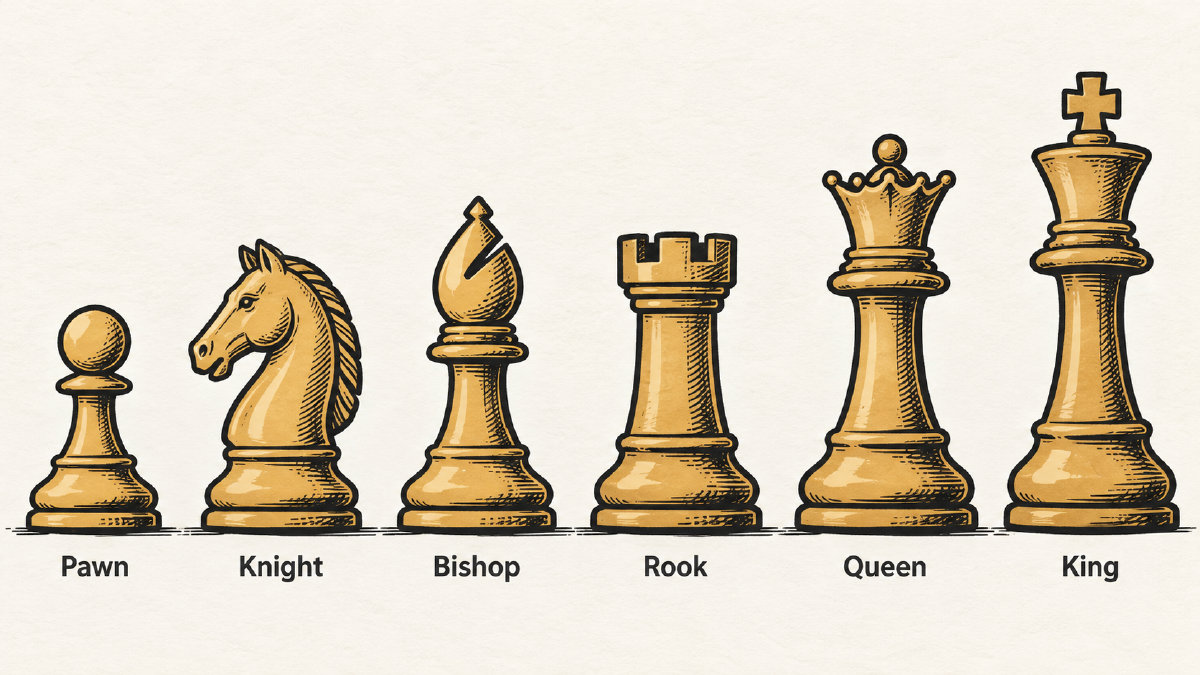
Finally, the king is usually the tallest piece on the board, with only one of them on each side. Kings are topped with crosses, which is where the name king comes from. And since he’s the most important piece on the board, you’ll also hear him referred to as “the king.” He’s usually the tallest piece on the board.
Of course, these are the traditional shapes of the pieces, and they’re called Staunton pattern pieces. If you’re using any other set of pieces, they may have different designs, but they’ll still be called by the same names.
How the Pieces Move
Now that you’ve learned the names of the pieces, you should be able to identify them on your own board. But just because you can recognize them doesn’t mean that you understand how they move yet. So let’s move on to that now.
Pawns move one square forward, or two from their starting square if both squares are clear. They capture one square diagonally forward.
Knights move in an L-shape: two squares horizontally or vertically, then one square perpendicular to that. They’re the only pieces that can jump over other pieces.
Bishops move any number of squares diagonally. Rooks move any number of squares horizontally or vertically. The queen can do both: she moves any number of squares horizontally, vertically, or diagonally. None of these pieces can jump over another piece.
The king moves one square in any direction, but he can’t move into check. Apart from pawns, pieces capture an opponent’s piece by moving to its square. You can’t move onto a square occupied by one of your own pieces, and no move may leave your king in check.
Special Rules and English Notation
Those are the basic moves. There are also special rules for castling, en passant, and pawn promotion. English notation uses K, Q, R, B and N for king, queen, rook, bishop and knight. Nf3 means a knight moves to f3; e4 is a pawn move, without a piece letter. Captures use x; pawn captures also give the starting file. Figurine notation replaces letters with piece symbols.