How the Rooks Chess Players Start With Move and Capture
Learn how rooks move and capture in chess, why they are worth about five pawns, and how to recognize blocked files and back-rank threats.
- Rooks
- Piece Movement
- Post-Game Analysis
On this page
The rooks chess players start with have been around for a while. They are the small castle or tower pieces in the corners, with two on each side of the board. On White’s side, they start on the a1 and h1 squares, whereas Black’s rooks begin on the a8 and h8 squares.
How Rooks Move and Capture
Rooks move straight, horizontally or vertically, as long as all intervening squares along their path are unoccupied. If there is an enemy piece on one of those squares, then the rook can capture it by occupying its square. (Note that the rook cannot jump over either side’s pieces.)
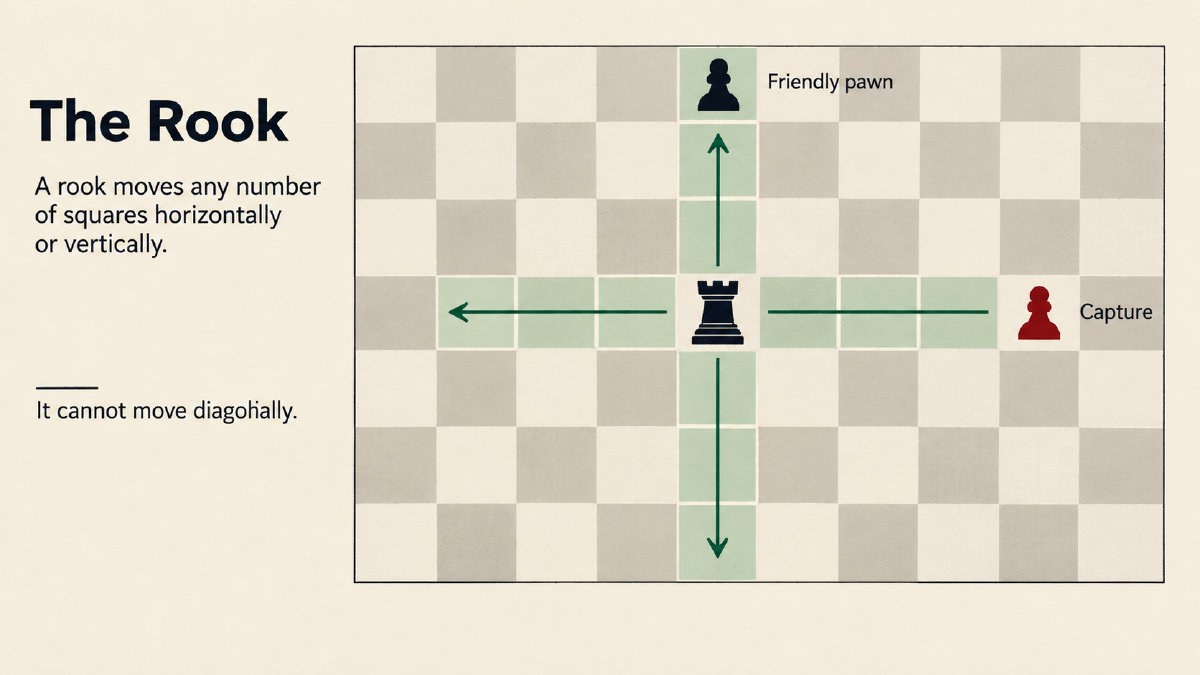
The rook has an approximate material value of five pawns, or about five points. It is generally nearly two pawns more than a bishop or knight, but worth approximately one pawn less than two minor pieces (e.g., a bishop plus a knight). Winning a rook for a bishop or knight is called winning the exchange.
Castling
Castling is the only coordinated king-and-rook move, where the king moves two squares toward the chosen rook, then the rook transfers to the square the king crossed. The king and the rook can’t have moved before this occurs, the squares between the king and the rook must be empty, and the king can’t begin in check, cross an attacked square or finish in check.
The files themselves become useful routes as the pawns provide a means to clear the way for them to enter the opponent’s territory. An open file is one where there are no pawns of either color. For White, a semi-open or half-open file has no White pawns, but at least one Black pawn; for Black, vice versa. A common development target for a rook is the first rank of an open or semi-open file.
Other pieces may block the rook’s ability to continue moving, however. But for practical purposes, the file becomes valuable when it offers accessible targets or entry squares. When a White rook sits on the seventh rank, for instance, it threatens the opponent’s second-rank pawns or possibly other targets. Alternatively, a Black rook sitting on the second rank might threaten a possible pawn attack, or restrict the movement of the enemy king, depending on the position.
Common Rook Mistakes
One of the more common mistakes is to allow the rook to become constrained by friendly blockers. Another is allowing the rook to become exposed early to cheaper attackers, such as knights, bishops or pawns. And yet another mistake is a king that is trapped behind its own pawns, especially if the back ranks aren’t safe, allowing a back-rank checkmate or loss of the rook. In this scenario, the enemy rook controls the eighth rank, so the king can’t escape unless the pawns are removed. In reality, though, whether a rook will be lost or the king checkmated depends on the complete position.
In reviewing a completed game, you might suspect a rook was moved improperly. You could import the game via the site’s documented browser tools, including from Chess.com or Lichess or pasting a PGN. You can then ask your browser-based Stockfish engine to review every move and use the editor to set up the position, select which side to move next, etc. There’s also an analysis board where you can input a FEN or PGN, then use it to move the pieces and analyze the lines using Stockfish.