How the Bishop Chess Piece Moves and Captures
Learn how the bishop chess piece moves and captures, why blocked diagonals matter, and how its three-point value depends on the position.
- Chess Pieces
- Game Review
On this page
The bishop is one of the most recognizable pieces in chess, second only to the king. In traditional Staunton design, it’s a slanted top with a distinctive slit, representing a bishop’s mitre.
How the Bishop Moves
Each player has two bishops. For White, they start at c1 and f1; for Black, they start at c8 and f8. Like the queen, each bishop moves diagonally across the board, but unlike the queen, the bishop cannot move horizontally or vertically. It can’t jump over pieces either. Each bishop stays on the same square color throughout the game, since diagonal moves can’t take it to the other color. Like the queen, the bishop can move backward along a diagonal as well. But it’s limited by occupied squares: there must be space between the bishop’s starting position and where it wants to go. That said, it doesn’t matter how far along the diagonal the bishop goes.
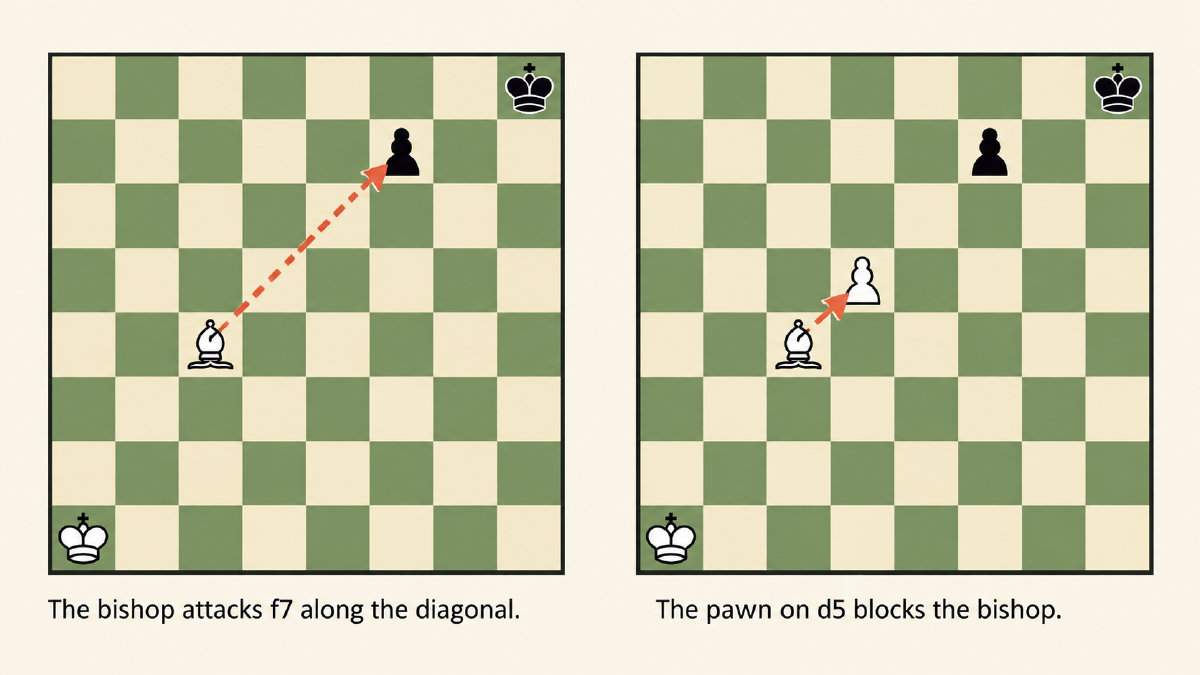
To capture, the bishop simply occupies an enemy piece’s square. So the bishop can move any distance along an unobstructed diagonal, then capture that enemy piece. It stops on the captured piece’s square, even if the square behind it is occupied.
Here’s an example of how that works. This is a fully specified teaching position:
White king on a1
White bishop on c4
Black king on h8
Black pawn on f7
It’s White’s turn to move. All other squares are empty. A legal capture would be Bxf7 (the bishop takes the pawn).
But now consider another variant, adding a new element: a White pawn on d5.
Now the bishop’s movement is blocked, so Bxf7 is no longer possible. The White pawn on d5 is a friendly blocker. The bishop can’t capture its own pawn with Bxd5 or move past it to reach f7.
Alternatively, here’s what happens when we add a Black pawn on e6 instead of a White pawn on d5:
This allows the bishop to capture e6, but prevents it from capturing f7. In both variants, however, the bishop remains available to capture on another move.
Legal Moves and King Safety
Bishops aren’t just about moving forward. They can also move backward. In fact, the ability to move back and forth along a diagonal is part of why they’re such powerful pieces, especially during the opening and middlegame, when their movement is more restricted. That said, it’s important to remember that a bishop’s move can’t leave its own king in check. The bishop can move to a square under enemy attack, though.
For example, here’s a rule-derived teaching position:
White king on e1
White bishop on e2
Black king on a8
Black rook on e8
It’s White’s turn to move. All other squares are empty. Is this a legal move? It isn’t. While the bishop could move to d3, doing so would expose White’s king to the Black rook. Rooks can move in any direction — horizontally, vertically — any number of spaces. But again, the rook can’t jump over pieces. Once the bishop moves to d3, there’s nothing between the rook and White’s king, so the king would be exposed.
There are other restrictions too. The bishop can’t move through friendly pawns or capture them either. But if the line of travel passes through a friendly piece, that’s illegal.
Bishop Value and Exchanges
Bishops have an approximate material value equal to knights. You can estimate the relative value of the bishop as three pawns. Of course, that varies depending on the position. Knights and bishops respond to different types of open lines, and they’ll respond differently in crowded pawn structures. When the exchange comes up, it really depends on the position. You can usually trade a knight for a bishop, but it’s not a universal verdict that it’s a good idea to do so. Sometimes, the opposite will happen: you’ll find yourself exchanging a bishop for a knight. Open lines tend to favor the bishop. Pawns blocking those lines can favor the knight, especially if your bishop is hemmed in. On an open board, having both bishops can give you an advantage.
You should definitely look at exchanges when playing, but you don’t have to evaluate everything. Use your intuition. Do you want to trade off your bishop? Or maybe your opponent wants to exchange?
Practice Positions and Review Completed Games
If you’re just getting started, try this practice route. Start with the first position I outlined above: recreate that and see what you think. Then move onto the next, then the next. Finally, try reviewing completed games that you’ve played on platforms like Chess.com, Lichess, or with PGN files. If you use ChessAnalysis browser tools, there are two ways to analyze your own games. One is the Board Editor, which allows you to set a position and side to move, copy out the FEN, and analyze with Stockfish. The other is the Analysis Board, which lets you explore a given position and its possible continuations, using Stockfish.
Another way to look at positions and examine potential captures is the Chess Game Review feature. Once you’ve finished a game, you can take it for review. Just make sure you’re not analyzing your own moves! For a completed game, trace each bishop’s diagonals to the first occupied square. A friendly piece blocks you; an enemy piece is a possible target. Check whether moving the bishop would leave your king in check. Then try continuations on the Analysis Board before deciding that an available capture is your best move.
Sources
More in Chess Basics
- Learn Chess Character Names and Recognize Every PieceLearn chess character names, recognize the six piece types, and understand their basic moves, point values and letters in game reviews.
- How the Rooks Chess Players Start With Move and CaptureLearn how rooks move and capture in chess, why they are worth about five pawns, and how to recognize blocked files and back-rank threats.