How En Passant Chess Captures Work
Learn en passant chess rules with White and Black examples, the immediate-reply requirement, and king-safety checks for completed-game review.
- Chess Rules
- Pawn Movement
- Game Review
On this page
En passant, which literally means “in passing,” is an unusual chess move. It’s the only capture in chess where the capturing piece doesn’t land on the square occupied by the piece it captures.
When you’re able to make an en passant capture, the opposing pawn has made a two-square advance on its previous turn. As the name implies, the capturing pawn doesn’t actually land on the square where the pawn it’s capturing advanced from, but rather moves forward as if it had moved just one square. The resulting capture looks like a normal diagonal capture onto the passed-over square. But unlike a regular capture, the opponent’s pawn vanishes from the square it originally occupied and is removed from the board.
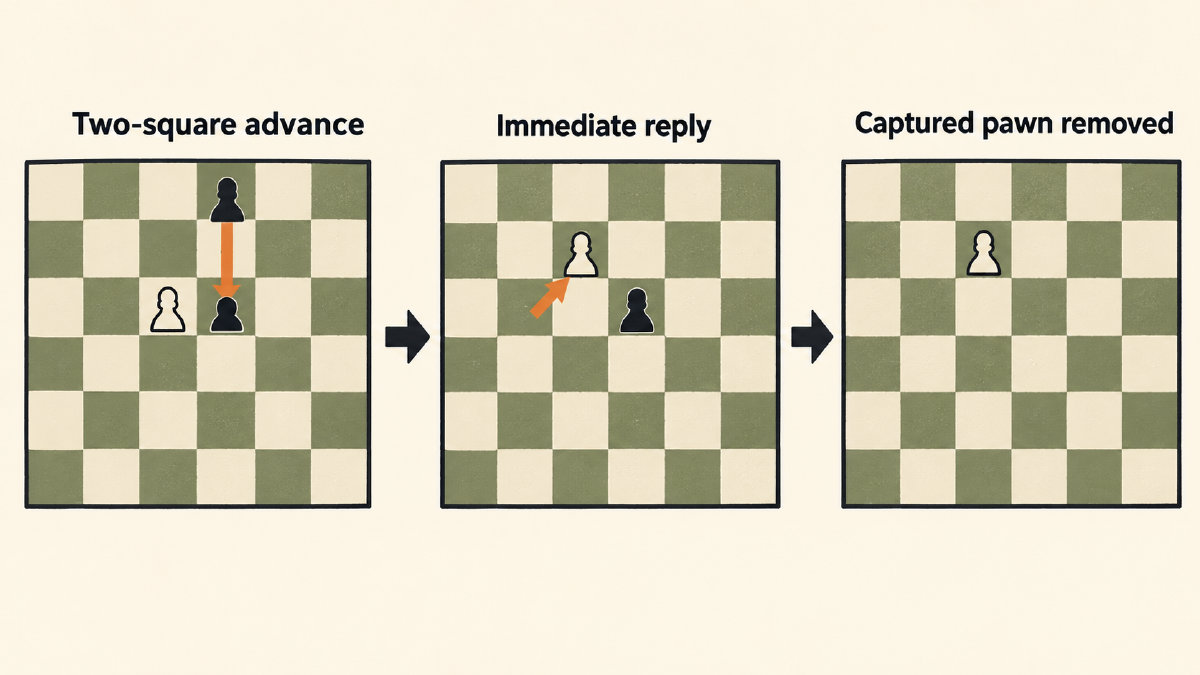
This article explains exactly how en passant captures work.
How en passant captures work
An en passant capture takes place when the capturing pawn lands on a square diagonally forward from its own square, with the opposing pawn’s own two-square advance taking place immediately prior to the capture. That’s what makes it so unique — because both pawns are on adjacent squares. Otherwise, you can’t make an en passant capture at all.
For example, suppose White moves a pawn from e5 to d6. From e5, this pawn attacks d6, the square that a Black pawn passes over when it advances from d7 to d5. Suppose, however, that the Black pawn was on d7, which would mean that it advanced two squares (d7-d5) during the preceding turn. Then the White pawn could move to d6, the square the Black pawn passed over, and capture the opposing pawn as though it had advanced only one square (from d7 to d6). In that case, the White pawn’s landing square is d6 and the Black pawn’s removal square is d5. The Black pawn is captured and disappears from the board.
Another way to think about this is that the White pawn on e5 attacks d6, the square the Black pawn passes over. A pawn can attack a square even when it’s empty. After d7-d5, White can capture en passant onto d6 on its immediate reply, provided the move leaves White’s king safe. However, if the opposing pawn had advanced only one square (from d7 to d6), then White could capture it normally on d6. In that case, no en passant opportunity arose. After d7-d5, if White chooses another move instead, the en passant opportunity expires.
White can choose to ignore an available capture, but not always. When it comes to making your move, if you’ve played correctly and the game is over, then you need to look at each possible en passant opportunity.
En passant notation
Let’s walk through a completed-game review, starting with the en passant notation.
The notation used to indicate an en passant capture is the same as any other pawn capture: the algebraic notation includes the destination square of the capturing pawn. Optionally, you’ll see an e.p. suffix appended to the notation, indicating that it was a capture en passant. For example, the White pawn may capture on exd6, or exd6 e.p. (the latter being optional). Similarly, Black’s pawn might capture on bxa3, or bxa3 e.p.
To check that a given en passant capture was indeed valid, you must determine two things:
-
Did the capturing side have a chance to make an en passant capture? Was the opposing pawn able to advance two squares during the previous turn?
-
Was that opportunity used? Was the en passant capture made on the immediate reply, before the opportunity expired?
The capturing pawn has already advanced three ranks from its starting square; the opposing pawn makes a two-square advance from its own starting square. In our example, we’ll take a pair of examples involving White and Black, respectively.
White
Let’s assume that the White pawn begins on e5. On its previous turn, did Black move a pawn from d7 to d5 (two squares)? If so, then White’s e5 pawn can move forward onto d6, diagonally. This pawn lands on d6, the square the Black pawn passed over. After this move, the Black pawn that advanced two squares is removed from its original square (d5).
Black
Black’s pawn starts on b4. Previously, was there a move from a2 to a4 (two squares)? If so, then Black’s pawn on b4 can move forward onto a3, diagonally, capturing the White pawn on a4 en passant. After this move, the White pawn that advanced two squares is removed from its original square (a4).
If either player chooses not to use the en passant opportunity, it will expire. There’s no way to save the opportunity for later. You must act on your turn.
King safety and legal moves
It is important to remember that even if you move the capturing pawn to its destination square, and remove the opposing pawn from its adjacent square, that does not necessarily guarantee a legal position. Why? Because the en passant capture can expose the capturing side’s king to check! A capture that leaves its own king in check is illegal. It turns out that simply moving the pawn to its destination and removing the opposing pawn is insufficient to ensure legality. King safety requires both the correct timing and placement.
When an en passant capture is possible, the player has the option to decline it, but not always. Let me clarify that difference: If there is another legal move available, then en passant is merely an optional choice. If, however, the en passant capture is the only legal move available, then you are obligated to play it. A player not in check who is forced to move via en passant cannot claim stalemate.
Reviewing en passant captures
In short, whenever you want to review a completed game and study the en passant captures, read the capture notation, then check the preceding advance and the immediate reply. Trace each pawn to its starting and ending square, reconstructing the capture. Finally, assess the king’s safety using the site’s browser analysis board, documented within the PGN input. Move pieces on the site’s board as needed, or paste a FEN or PGN and press Load position. Press Analyze with Stockfish. Stockfish will then analyze each position as you move through the game.
Sources
More in Chess Basics
- How to Recognize and Avoid Stalemate in ChessRecognize stalemate in chess, distinguish it from checkmate, and review your completed game's ending to spot how the draw happened.
- How to Choose Great Opening Moves in Chess as a BeginnerChoose great opening moves in chess with 1.e4 or 1.d4, purposeful development and king safety, then review those decisions in completed games.
- How to Recognize Zugzwang in Chess EndgamesRecognize zugzwang with a king-and-pawn example, understand why whose turn it is matters, and learn what to check in completed-game reviews.