How the Chess Rating System Works on Chess.com, Lichess and FIDE
Understand the chess rating system: how Elo and Glicko change your rating, why platform ratings differ, and how ratings relate to game accuracy.
- Chess Ratings
- Game Review
On this page
A rating is an estimate of your performance within a player pool. However, this doesn’t mean that a stronger rating guarantees you’ll win against another player; rather, it represents how probable your performance is against an opponent. A similar player could have different ratings in different pools, as well.
Different platforms and player pools
Chess has three major platforms: FIDE, Chess.com and Lichess, which all have different ways of calculating ratings. Because of this, we cannot simply convert between the rating systems without knowing the context of the rating itself. For example, if I tell you I play at 1700 Elo on Lichess, but only 1500 on Chess.com, this tells us something about the overall difficulty of games played, but nothing specific about either individual system. If you know my games are rated for time control, then you can get more information. But again, not much.
FIDE’s rating system is based upon the Elo system, which was invented by Arpad Elo, a physics professor. The Elo system calculates the difference in strength between two players using expected scores (which can be thought of as points per game) and how many games are played. Each rating period includes the calculation of all these scores across a set number of games. This calculation is also done by individual rating periods. An “expected score” is the points a player is expected to score per game on average, counting a draw as half a point. In addition, you earn ½ point for a draw, and 1 point for a win.
There are several tables that define what each rating difference means. One such table is from FIDE, which defines expected scores by the rating gap between two players. For instance, according to FIDE, a rating gap of 99–106 points gives the higher-rated player an expected score of 0.64 and the lower-rated player 0.36.
Calculating a rating change
However, here’s where you can see the difference between what happens when you calculate a rating change versus what actually occurs during a rating period.
Take the example below: You’re an adult who has been playing for some years, so your rating is 1500. Let’s say you play someone with a 1600 rating. The rating difference is +100. FIDE’s table gives expected scores of 0.64 for the higher-rated player and 0.36 for the lower-rated player at a gap of 99–106 points, so your expected score is 0.36. That means you’re expected to score 0.36 points per game on average, while your opponent is expected to score 0.64. (Remember that draws are half-points, so they contribute 0.5 points.) Therefore, if you beat them, you’ve earned one point, whereas the expected score is 0.36, which gives you a positive contribution of +0.64. If you draw, you’d get +0.14, while a loss would give you −0.36. The total score-minus-expectation differences would be added up over a tournament or rating period, and then multiplied by K. (K is the development coefficient.) Finally, the resulting change is rounded to the nearest whole number, with halves being rounded away from zero.
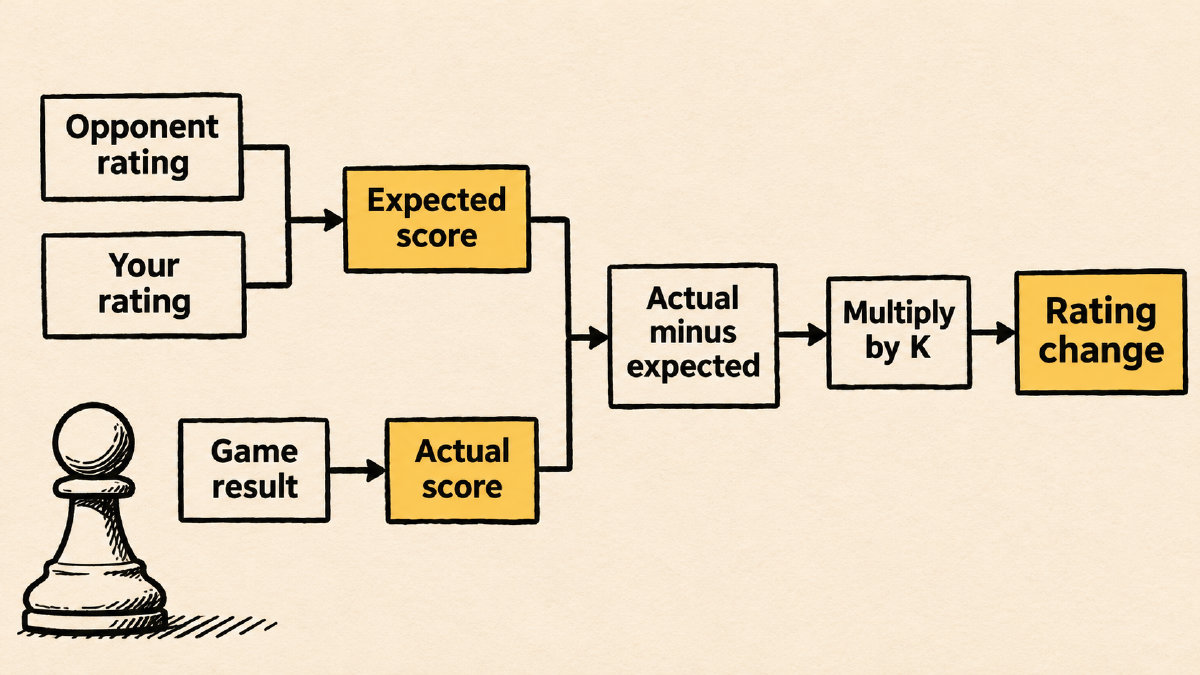
So, how does the rating change? Well, it depends on whether the player performs above or below expectations. Here’s a simple breakdown:
Let’s take the case of a 1500-rated player playing against a 1600-rated opponent, with K = 20. As before, your expected score is 0.36. Let’s say the actual score is a win. Then, the game contribution is K × (actual score − expected score). So that’s 20 × (1 − 0.36) = +12.8. If instead the game ended in a draw, the contribution would be 20 × (0.5 − 0.36) = +2.8, and for a loss, 20 × (0 − 0.36) = −7.2.
Now sum up all of these contributions. Again, the exact amount will vary depending on the games played, but let’s suppose that the final result is +10. These contributions already include K, so the rating change is +10 before rounding. We don’t multiply by K again or divide by the number of games.
Now the next step is to round the number to the nearest whole number, with exact halves rounded away from zero. So, in our example, the player would have an increase of +10 points, rounding to +10.
The formula used to estimate the rating change is essentially a continuous formula. But the official rating-period calculation is based on a lookup table. You can use our Elo calculator to estimate your FIDE rating change; the official calculation uses FIDE’s expected-score table.
Development coefficients and rating uncertainty
What makes this a bit confusing is that the rating system used on FIDE isn’t quite the same as what online sites like Chess.com and Lichess use, even though both use the Glicko algorithm, albeit with some differences. Chess.com uses Glicko, while Lichess uses Glicko-2.
FIDE uses a set of development coefficients to determine how rapidly your rating changes after a game. When new players join FIDE, their development coefficient starts at 40 until they complete at least 30 games, at which point it drops to 20. While your rating is under 2400, the coefficient is 20, subject to other rules. After your published rating reaches 2400, it becomes 10, and stays there even if your rating drops below 2400.
Additionally, FIDE uses K = 40 for youth players until the end of the year of their 18th birthday, as long as their rating remains under 2300. If the number of games in a rating period multiplied by K exceeds 700, it reduces K to the largest whole number that keeps that product at or below 700, which helps maintain stability within the rating pool.
In contrast, most of the sites you use don’t use development coefficients, but track uncertainty alongside your rating. This results in more frequent changes for new or infrequent players, who might experience larger increases or decreases in their rating.
Rating accuracy and completed game review
Again, the question of how accurate the rating is comes into play. Remember, a rating is just an estimation of your relative performance within the player pool. But your accuracy is a measure of your ability to make quality moves. That’s the difference between what happens in one game, and what happens in a series of games.
You can check your accuracy through evaluations before and after making a move. But completed-game review is another thing entirely, allowing you to look at a finished game and evaluate why you made certain moves and what you should have done. Reviewing completed games shows you exactly where you need to improve, and recurring mistakes show you where to focus your practice.
Of course, you can’t expect to improve overnight, no matter how high your rating may rise. What’s important is looking at your rating history within the same platform and time control. Your progress is going to be consistent across all of these measures, assuming you’re reviewing games accurately and practicing consistently.
Rating inputs are based on the score of the game and your rating expectation. Accuracy, however, is based on the quality of the moves you make in one particular game. Evaluations before and after individual moves allow you to determine if you’re playing correctly. Completed-game review lets you examine exactly why you played the way you did. Recurring mistakes reveal where you should be practicing the most. Ultimately, rating is about repetition — playing games, learning from mistakes and repeating the right techniques.
Sources
More in Chess Basics
- How the Queen Chess Piece Moves, Captures and Stays SafeLearn how the queen chess piece moves and captures, what its nine-point value means, and how to review queen-safety mistakes after a game.
- How Fools Checkmate Works and How to Avoid ItUnderstand fools checkmate, usually called Fool's Mate: the two-move sequence, why White cannot escape, and pawn mistakes to review afterward.
- How to Use Chess Piece Points to Count Material and Compare TradesLearn chess piece points, count material after exchanges, and understand why activity, king safety and engine evaluations can outweigh the totals.