How to Get Better at Chess With a Game Review Routine
Learn how to get better at chess by reviewing completed games, finding recurring mistakes and turning them into a repeatable practice routine.
- Game Review
- Training Routines
On this page
I recently had the opportunity to talk with GM Avetik Grigoryan, and he shared his thoughts on how to get better at chess. His answer was pretty straightforward.
Study -> Practice -> Fix -> (Repeat)
He said that if you study something new and then go out and practice it in games, but keep making the same mistake over and over again, then you need to fix that mistake and repeat the cycle.
But when I asked him what exactly does “fix” mean, he told me that it’s about finding the root of the problem. If you’re missing tactical ideas, then you need to do some puzzles. If you’re confused strategically, then you need to look at model games. And if you’re repeating mistakes, then you need to focus on those patterns.
So I thought it would be helpful to share my own game review routine. It’s not perfect, but it’s worked well for me over the years.
An Adaptable Session Allocation
The first thing I want to mention is that this routine is adaptable. Obviously, depending on your schedule and other commitments, you might have more or less time available for studying and practicing. So here’s how I generally allocate my time.
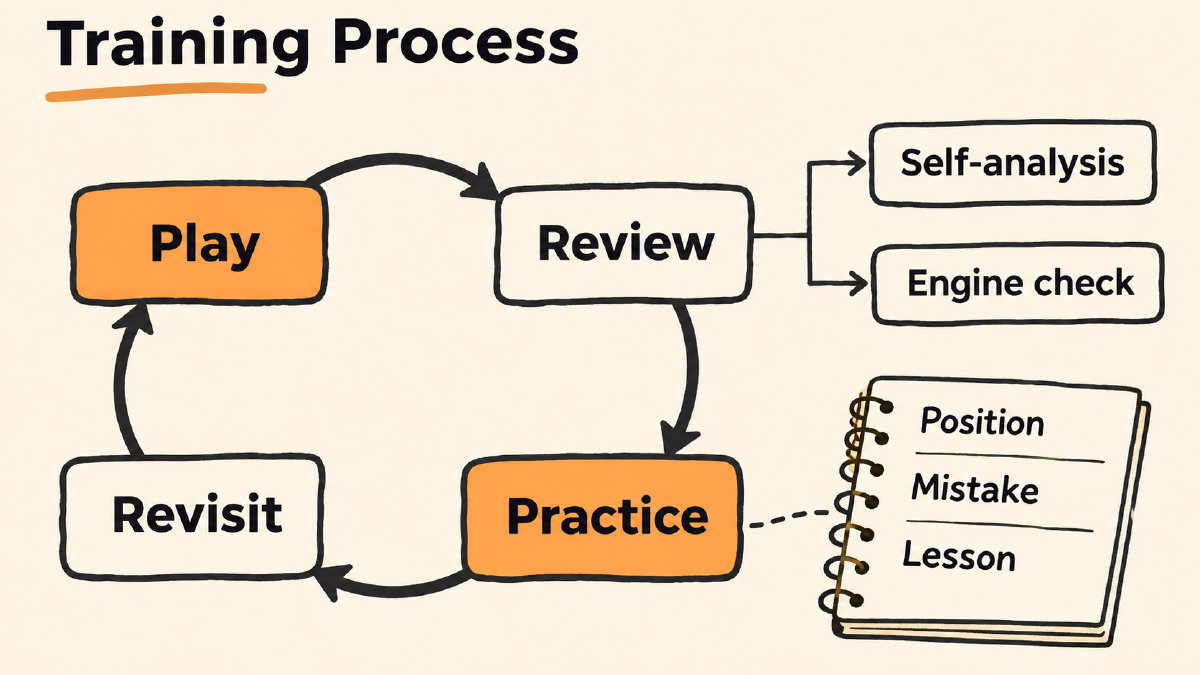
For most days, I’ll play 1-2 games online. Then I’ll spend 20-30 minutes reviewing my own games. If possible, I’ll try to capture my thoughts immediately after finishing a game. If I can’t do that, I’ll make sure that I come back to my games as soon as possible. After my initial self-review, I’ll spend another 20-30 minutes using an engine to check my games and then practice applying what I’ve learned.
On some days, I’ll play several games in one sitting. On those days, I’ll spend longer playing games, and then return to my review session later. But even then, I’ll still separate my game sessions from my deeper analysis and review. My point is that there’s a difference between just playing games and doing actual game analysis.
My Own Game Review Routine
I like to start by replaying the game. When I replay a completed game, I’m trying to preserve my original reasoning so that I can refer back to it later if needed. That’s why I always record my thoughts right after the game ends. In fact, WGM Natalia Pogonina has a great tip for recording your thoughts immediately after the game ends, so that you can explain your mistakes later.
After I finish my initial self-review, I’ll use an engine to analyze my game. This helps me find any missed tactical ideas, or any strategic confusion that I may have had. Once I’ve identified a specific area of concern, I’ll move on to targeted practice. For example, if I missed a tactical idea during the game, I’ll work on relevant puzzles. If I was confused about a strategic plan, I’ll look at model games. And if I made a repeated mistake, I’ll focus on those patterns.
One thing I’ve found very useful is keeping track of recurring mistakes. If I notice that I keep making the same mistake over and over again, I’ll add it to a list of recurring mistakes. Then I’ll choose one of them to work on during my next practice session. It’s amazing how much progress I’ve made in recent months just by focusing on my recurring mistakes and working on each of them individually.
Independent Review
In addition to my general game review, I also like to independently review games. I think this is especially important for players who are new to computers. When we play against humans, we’re used to thinking through our moves, calculating variations, and analyzing positions. During review, I’ll take time to calculate my own alternatives before checking the engine’s suggestions.
That’s why I like to independently review my own games. By replaying a completed game, I can see what my thinking process was like during the game. I can look back at my own decisions and see where things went wrong. Then I can calculate my own alternative plans and see if they’re better than what I actually played. And finally, I can compare my own calculations with the engine’s suggestions.
I’ve started using this technique with both Chess.com and Lichess. The beauty of these platforms is that they allow me to replay completed games. I can view all of my wins, losses, and draws, and I can replay them independently. Here’s how it works…
First, I’ll replay a completed game. I’ll try to remember what I was thinking at the time. I’ll try to remember what my original idea was, and I’ll try to remember what my candidate variation was. Then I’ll go ahead and calculate my own alternative plan, and I’ll record my notes. Finally, I’ll click on the arrow to move the piece, and I’ll let the engine show me what I missed.
This gives me two things: (1) it preserves my original reasoning, and (2) it shows me what I missed in my own calculation.
You can do this with any of your completed games. You can even do it with someone else’s game if you’re curious. Just download their PGN file and open it up in ChessAnalysis.
Once I’ve done my independent review, I’ll move on to browser-based Stockfish analysis. This will give me a chance to test my saved candidate against the opponent’s reply and against the relevant alternatives. This isn’t about the evaluation number. This is about seeing what a move permits or prevents beyond its evaluation number.
Game Analysis and Correction
Finally, I’ll move on to correcting my mistakes. I’ve found that this is best done by creating a manual record. I’ll save the position, write down the original idea, the checked reply, and the lesson. Then I’ll hide those notes and solve the position again.
If I can’t figure it out on my own, I’ll look at the notes I wrote down and try again. If I still can’t figure it out, I’ll ask for help. I’ll either send the position to a friend or I’ll post it on a forum. Either way, I’ll make sure that I understand why my original idea wasn’t correct. I’ll make sure that I understand why my checked reply was the right move. And I’ll make sure that I understand the underlying principle that explains why my original idea wasn’t correct.
It’s amazing how much progress I’ve made in recent months just by focusing on my recurring mistakes and working on each of them individually. I’ve noticed that I’m able to explain the checked reply now, and I’m able to recognize the theme when it comes up in subsequent games.
And I’ve noticed that I’m actually making progress!
Sources
More in Chess Improvement
- How Fools Checkmate Works and How to Avoid ItUnderstand fools checkmate, usually called Fool's Mate: the two-move sequence, why White cannot escape, and pawn mistakes to review afterward.
- How to Win Chess Games: A Beginner’s Guide to Better DecisionsLearn how to win chess games with checkmate basics, safer pieces, tactical awareness, sensible trades and a completed-game review routine.