How to Win Chess Games: A Beginner’s Guide to Better Decisions
Learn how to win chess games with checkmate basics, safer pieces, tactical awareness, sensible trades and a completed-game review routine.
- Beginner Chess
- Tactics
- Endgames
- Game Review
On this page
I’ve been asked several times over the years about how to win chess, how I go from a beginner to a master, and what I think is the most important factor in improving. My answer has always been consistent — it’s not that I’m particularly talented at chess, or that I have an eidetic memory, or that I can see 10 moves ahead. It’s simply because I practice. And when I say “practice,” I mean playing games, analyzing them, and learning from my mistakes.
But even though I’ve played thousands of games, I still make mistakes. I still lose games. And sometimes I lose games because I made a decision that was clearly wrong. But here’s the thing — those decisions aren’t random. They’re all based on something. That’s why I believe that the most important skill you can develop as a chess player is making better decisions.
In this article, I’ll show you how to evaluate your options before making a decision so that you can avoid the most common blunders and inaccuracies. And I’ll also give you some practical examples to help you understand how these principles apply in actual play.
Winning Material vs. Ending the Game
Winning material can help you win a game of chess, but it doesn’t end the game. Checkmate does. You can also win if your opponent resigns or runs out of time, provided the applicable rules allow a win.
These are two very different things, and they require different types of thinking. Capturing material is usually easy. If you spot an undefended bishop that your knight can capture safely, then you can just take advantage of it by moving your knight onto the bishop’s square. The result? You’ve captured a bishop. Easy.
Ending the game with checkmate is much harder. It requires you to find a way to trap your opponent’s king so that he has no escape. This means looking for patterns such as forks, pins, skewers, and discovered attacks. It also means being able to look ahead several moves to find the perfect sequence of moves to trap the opposing king.
And there’s one final difference between winning material and ending the game — if you win material, you might still lose the game. After you’ve captured more pieces than your opponent, you might still lose because you didn’t protect your own king properly. On the other hand, if you end the game with checkmate, then you’ve won the game.
That’s why I like to use the word “win” instead of “end.” Getting a winning position in chess doesn’t mean that you’ve ended the game. In fact, you can end the game without winning it. For example, you can end the game with stalemate, which means that your opponent has no legal moves left, but his king isn’t in check. If it’s his turn to move, that’s a draw. Checkmate means his king is in check and he has no legal way to escape the check. The game ends there. You never capture the king.
So the goal isn’t to end the game, it’s to win the game. And the best way to do that is to start planning ahead.
Central Influence, Minor-Piece Development, and King Safety Prepare Your Attack
If you want to win a game of chess, you need to plan ahead. And if you want to plan ahead, you need to know where you’re going.
That’s why the first step in any opening is to gain central influence. That’s why you play d4 or e4, or both. That’s why you don’t just play d4 and then immediately castle. You want to develop your minor pieces quickly. That’s why you don’t just play d4 and then immediately trade your bishop for your opponent’s knight. You want to develop your knights and bishops to active squares. And that’s why you don’t just develop your knights and bishops, and then immediately move your queen off its starting square. You want to develop your king’s safety, so that you can attack.
All of these things are priorities in the opening, but none of them is a winning formula. There are plenty of openings that lead to wins, and plenty of openings that lead to losses. The key is to learn how to evaluate your options before making a decision.
The short opening sequence below shows central influence and knight development.
-
e4 e5
-
Nf3 Nc6
-
d4 exd4
-
Nxd4
White has already developed his knight and gained central influence, but he hasn’t castled yet. White’s central play has been very strong, and he’s developed his pieces well. But does that guarantee a win?
No. Because it depends on what happens next.
Practical Decision Check
Before choosing a move, ask yourself, “What is my opponent trying to do?” If you know what your opponent is trying to do, then you can decide whether your proposed move will help or hinder your plan.
For example, suppose that your opponent has a pawn on e5, and you’re considering playing f4. Before you commit to playing f4, ask yourself, “What is my opponent trying to do?” If your opponent is trying to push his pawn to e4, then you should probably not play f4. If your opponent is trying to develop his knight to c6, then you should definitely not play f4.
Another question to ask yourself before choosing a move is, “Will this move leave any of my pieces hanging?” If yes, then don’t play it unless you’re absolutely sure that your opponent won’t capture it.
Of course, you don’t always have time to consider every possible threat before choosing a move. Sometimes you just have to rely on your intuition. But you should always ask yourself, “What is my opponent trying to do?” before committing to a move.
Forks, Pins, Skewers, and Discovered Attacks
Knowing how to fork, pin, skewer, and use discovered attacks can help you win more games of chess. These are recurring tactical patterns that appear in every level of chess. You can find them in the games of the world’s greatest players, and you can also find them in the games of beginners who are still learning how to play.
But again, none of these patterns guarantees a win. Even the world’s greatest players draw games. So you shouldn’t expect to win every game that you play. You should expect to lose some games. What you should never expect is to lose a game because you missed an obvious tactic.
Conditional Simplification When Ahead
When you’re ahead, you can simplify the position by exchanging pieces. But you have to be careful. Exchanging pieces reduces the number of pieces on the board, and that reduces the number of complications. So if you’re ahead, you want to keep your advantage, not let it disappear in a complicated position.
On the other hand, if you’re behind, you want to complicate the position. More pieces on the board means more chances to get lucky. It also means that you have more opportunities to find an error in your opponent’s play.
So when you’re ahead, you want to exchange pieces, but only if the resulting position preserves your advantage. And if you’re behind, you want to complicate the position, but only if the resulting position preserves your advantage.
Endgame Study
It’s not enough to just win a game of chess. You have to finish it. That means studying endgames. You have to learn how to convert a small advantage into a finished game.
That’s why I recommend studying king-and-pawn endings. You’ll learn how to control the center, how to create space, and how to limit your opponent’s options. You’ll also learn how to use the opposition to force your opponent into a corner. And you’ll learn how to use basic rook endings to create pressure on your opponent’s king.
But remember, even if you study endgames, you still have to learn how to finish the game. That means practicing until you can convert your advantages into finished games.
One of the best ways to do that is to study positions that are drawn, and then try to find a way to win. It might seem strange, but it’s actually quite simple. Just pick up a book, open it to a random page, and try to find a way to win. If you can’t find a way to win, then read the solution. Then try to find another way to win. Repeat this process until you’re comfortable with the position.
Stalemate Risk
One of the biggest risks that you face when you’re ahead is the risk of stalemate. Stalemate occurs when your opponent has no legal moves left, but his king isn’t in check. That sounds pretty straightforward, right? It seems like a fairly simple concept.
But the problem is that it’s often difficult to tell whether a position is stalemate or not. That’s why I recommend studying stalemates. The more familiar you are with stalemate positions, the easier it will be to recognize them in your own games.
Conclusion
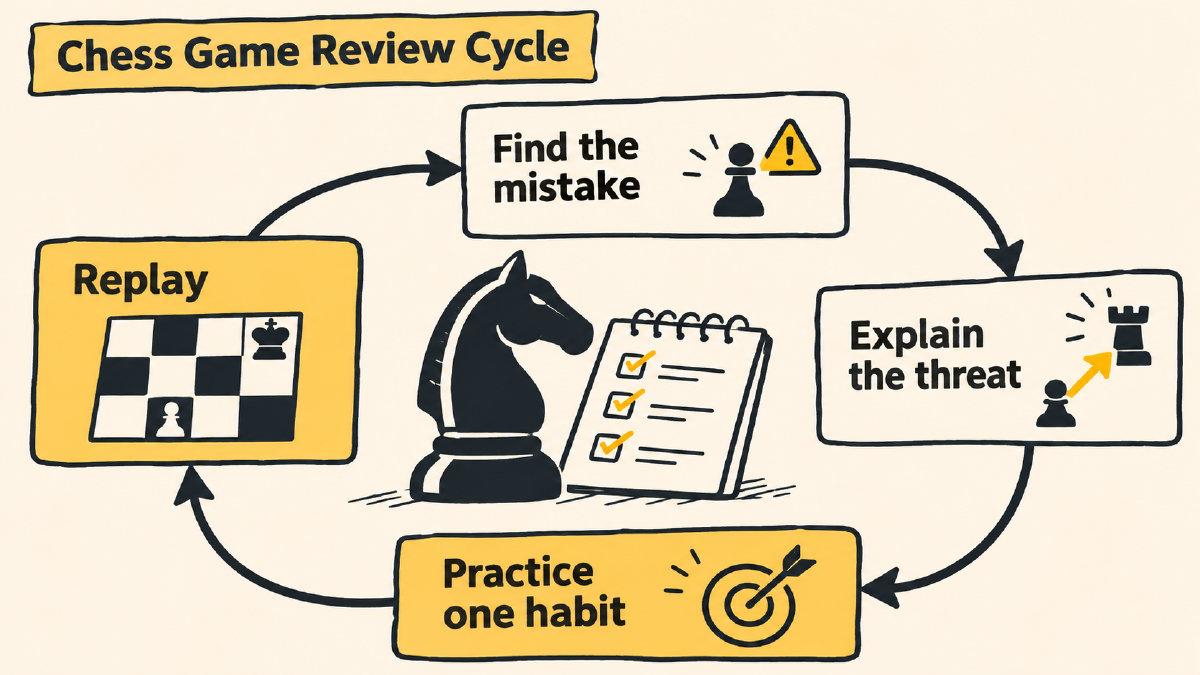
The most important skill that you can develop as a chess player is making better decisions. And the best way to do that is to review your completed games. Don’t just play games. Play games, analyze them, and learn from your mistakes. First, replay the game on your own. Find a decision that cost you something, or one that you still don’t understand. Then use an engine to check it. If you use ChessAnalysis, you can import your game or enter its PGN and review it with Stockfish in your browser. But don’t just look at the suggested move. Try to understand why your decision was wrong. Write down the mistakes you keep making, and use that list to decide what to practice next.