How Is Chess Played? A Beginner’s Guide to Your First Game
How is chess played? Learn board setup, piece moves, turns, special rules and game endings, then review your first completed game.
- Chess Rules
- Beginner Chess
On this page
If you’re new to chess, then you’ve probably heard the term “checkmate” and wondered what it means. In fact, the answer to “how is chess played?” starts with the goal of the game — to put your opponent in checkmate. Checkmate is when your opponent’s king is under attack (in check), but has no legal escape.
So if you’re just learning how to play chess, then here’s a beginner’s guide to your first game.
Let me start by telling you that the basics of how to play chess are pretty simple. Once you learn the basic rules, you’ll be amazed at how quickly you’ll get comfortable playing this fun and challenging game.
You’ll need two players, a standard 8×8 board with alternating colored squares, and each player will have an army of 16 pieces. The armies look like this:
The white pieces start on ranks 1 and 2, with pawns on rank 2. The black pieces start on ranks 8 and 7, with pawns on rank 7. Each side starts with one king, one queen, two rooks, two bishops, two knights, and eight pawns.
Now that you know how many pieces there are and where they start, let’s talk about the board itself. Here’s how to set up a chessboard: give each player a light square in the near right corner. From a1 to h1, place White’s rook, knight, bishop, queen, king, bishop, knight, and rook. Put Black’s pieces in the same order from a8 to h8, with White’s pawns on rank 2 and Black’s pawns on rank 7.
White always goes first. That means White moves first, then Black replies, then White again, and so on. And the squares on the board have names, which are used to identify where pieces are located and where they can move.
Here’s how the squares are named. The files are labeled from left to right as a through h, and the ranks are numbered from bottom to top as 1 through 8.
So the bottom left square is a1, and the top right square is h8. The top left square is a8, and the bottom right square is h1.
One thing that may confuse beginners is that the board looks different depending on whose perspective you use, but the square names stay the same. If I’m looking at the board from my own side (i.e., the side with the white pieces), then the light square at my near right corner is called h1. But if I were looking at the board from my opponent’s perspective, then that same square would still be called h1. So the names of the squares don’t change with the viewpoint or whose turn it is.
That said, I’ll try to use the square names from my perspective whenever possible. For example, when I refer to a1, that’s the square at the lower left of the board from my perspective. If you want to see the square names from your perspective, you can mentally flip the board over or imagine standing on the other side of the table.
Now that we’ve got the board figured out, let’s take a look at how the pieces move. Here’s a quick overview of all six types of pieces and how they move.
Pawn
Pawns move forward toward the opponent’s side of the board. On their first move, pawns can move either one or two squares forward. After their first move, pawns can only move one square forward. Pawns capture diagonally forward.
Knight
Knights move in an L-shape. They can jump over other pieces, so they don’t have any problems moving around them.
Bishop
Bishops move diagonally. They can move any number of squares, but they must stay on the color of square they started on. They cannot jump over other pieces.
Rook
Rooks move straight horizontally or vertically. Like bishops, they can move any number of squares, but they cannot jump over other pieces.
Queen
Queens move any number of squares horizontally, vertically, or diagonally. She’s the most powerful piece on the board.
King
Kings move one square in any direction. Kings can never be captured or removed from the board. The object of the game is to checkmate your opponent’s king. A knight’s L is two squares in one direction, then one sideways. A pawn’s forward path must be empty, and queens cannot jump over pieces. You capture by landing on an enemy piece’s square and removing it. You can’t land on your own pieces. Every move must leave your king safe, so a king can’t move onto an attacked square.
How the Game Ends
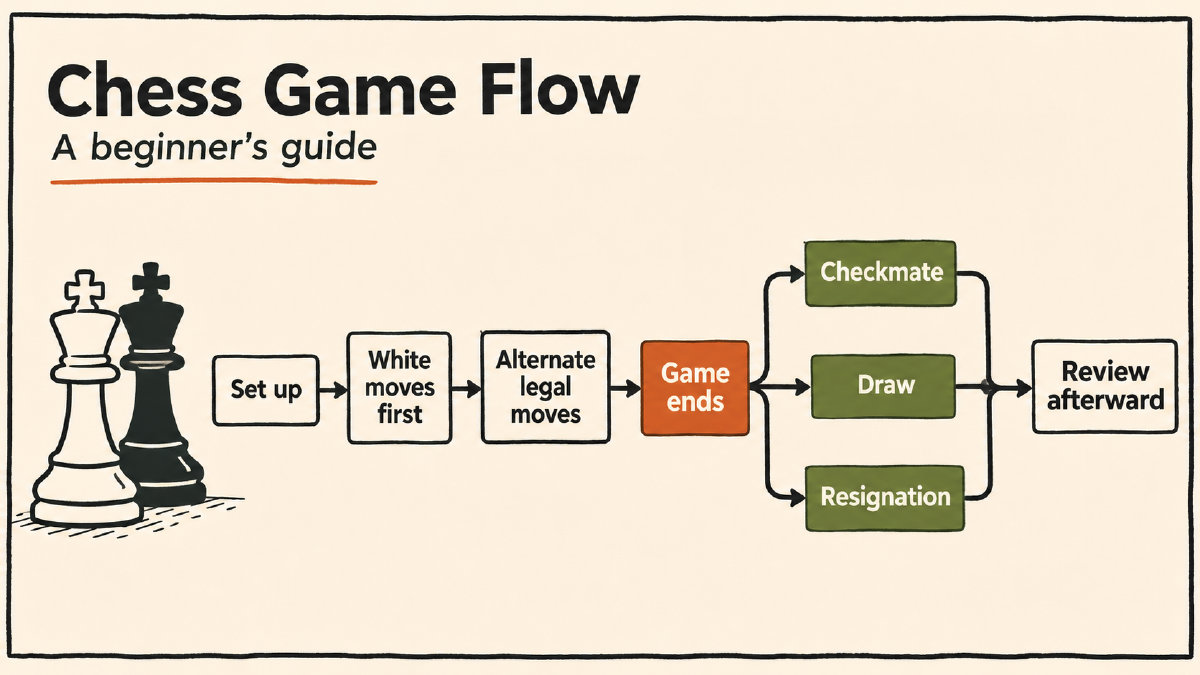
Now that you know how each piece moves, you might be wondering how the game ends. There are several ways for a game to end, but the most common way is checkmate. Checkmate occurs when a king is in check (under attack) and has no legal escape. You must answer check immediately by legally moving your king, capturing the checking piece, or blocking the attack where possible. You can’t castle out of check.
But there are also stalemates, which occur when a player has no legal moves, but his king isn’t in check. Stalemates are draws, not losses.
There are also agreed draws, where both players agree to stop the game and declare it a draw. You’ll hear this type of draw referred to as a draw by agreement.
And finally, there’s resignation, where a player concedes the game and gives up. This is usually done when a player feels he’s lost the game.
Special Rules of Chess
Now that you know how the game ends, let’s talk about some of the special rules. One of the more interesting special rules is castling. Castling is a single move that moves both your king and your rook. It’s the only time when you can move two pieces in one turn. Move your king two squares toward the chosen rook, then put that rook beside the king on its other side.
Castling is allowed only if the following conditions are met:
Your king hasn’t moved yet.
Your rook hasn’t moved yet.
All of the squares between your king and your rook are empty.
Your king is not currently in check.
Your king does not pass through a square that is attacked by an enemy piece.
Your king doesn’t end up in check after castling.
Another interesting rule is pawn promotion. When a pawn reaches the far end of the board, it promotes to another piece. Usually, it’s promoted to a queen, but you could promote to a knight, bishop, or rook instead. The chosen piece type doesn’t need to have been captured.
And finally, there’s en passant, which is a special type of pawn capture. En passant is available only when an opposing pawn makes its initial two-square advance and passes a square that is attacked by your pawn. If you do nothing, then the opportunity expires on your next move. On that immediately following turn, move your pawn onto the passed-over square and remove the opposing pawn. Your king must still be safe.
As long as you remember these special rules, you should be fine playing a casual game of chess. Let’s take a look at a very simple sequence of moves to help illustrate how the game works.
e4 e5 Nf3 Nc6 d4 exd4 Nxd4
This sequence shows a very basic game of chess. White opens with 1. e4, advancing his e-pawn from e2 to e4. Black responds with 1…e5, advancing his e-pawn from e7 to e5. Then White plays 2. Nf3, developing his knight from g1 to f3. Black develops his knight from b8 to c6 with 2…Nc6. White follows up with 3. d4, advancing his d-pawn from d2 to d4. Black captures the pawn on d4 with 3…exd4, bringing his e-pawn from e5 to d4. And finally, White recaptures with 4. Nxd4, bringing his knight from f3 to d4.
It’s important to note that the players alternate turns, but the squares they move to don’t have to alternate colors. So White moves first, then Black, then White, and so on.
I hope this helps you understand how to play chess. Try a game with friends or family over the board, or play online. Afterward, replay it yourself and pick one confusing decision before importing the completed game or its PGN for Stockfish review. If you’re interested in seeing how the game looks from a computer perspective, you can import a completed game into ChessAnalysis.com and review it using Stockfish. Or you can simply open a browser and review the game with the engine after the game has ended.
Sources
More in Chess Basics
- How the Queen Chess Piece Moves, Captures and Stays SafeLearn how the queen chess piece moves and captures, what its nine-point value means, and how to review queen-safety mistakes after a game.
- How Fools Checkmate Works and How to Avoid ItUnderstand fools checkmate, usually called Fool's Mate: the two-move sequence, why White cannot escape, and pawn mistakes to review afterward.
- How to Use Chess Piece Points to Count Material and Compare TradesLearn chess piece points, count material after exchanges, and understand why activity, king safety and engine evaluations can outweigh the totals.