Chess Game Terms Explained for Beginners
Learn common chess game terms with simple examples, from checkmate and tactical patterns to material, tempo and completed-game review scores.
- Chess Terminology
- Chess Tactics
- Game Review
On this page
Chess Game Terms: Files, Ranks, Center
The first step to describing a position is to define where it occurs. A file (or column) is a vertical column of squares on the board. Each has a letter: a through h, left to right.
A rank (or row) is a horizontal row of squares on the board. The ranks are numbered 1 through 8 from bottom to top.
Together, they allow a chess player to identify a particular square with two coordinates, such as b3 or e5. That’s all that’s needed, but there’s more to it than that. One way to think about the game’s spatial vocabulary is by its center. The center consists of four central squares: d4, e4, d5 and e5. Pieces have different effects based on their proximity to this area.
Four terms to know here are check, checkmate, stalemate and resignation. There’s also a draw, which ends the game with neither side winning or losing.
Check, Checkmate, Stalemate and Resignation
Check is when a king is under attack. You must respond to a check immediately, either by capturing the attacker, blocking the attack or moving the king out of check. (If you can’t do any of these, then it’s checkmate.) If you’re unable to respond, your opponent has won the game.
But suppose that it’s your turn, you don’t have any legal move, and your king isn’t in check. That situation produces what’s called a stalemate, which results in a draw. But if you choose to resign before you’re actually in checkmate, that means you’ve conceded defeat — and thus, the game is over.
Castling, Promotion, Underpromotion and En Passant
In addition to the normal moves, there are a few special cases. Castling involves both a king and one of its rooks. To castle, the king must move two squares toward a rook. The rook then moves to the square crossed by the king during the move. The king and involved rook must not have previously moved, and the squares between them must be unoccupied. Also, the king can’t be in check at any point during the castling maneuver; neither can it end up on an attacked square or cross one.
Promotion is simple enough: When a pawn reaches the last rank, it becomes another piece. Most often, that will be a queen, but you may also promote to a knight, bishop or rook. This latter process is known as underpromotion.
Finally, there’s en passant. This allows a pawn to capture an adjacent enemy pawn if it has advanced two squares on its first move. Imagine that the black pawn has just advanced from e7 to e5, while a white pawn is sitting on f5. In effect, the pawn has passed by the white pawn. White would be able to capture the black pawn by moving from f5 to e6.
In reality, it’s as if the advancing pawn moved only one square. And remember: You must reply immediately.
Opening, Middlegame and Endgame
The opening begins when the players move pieces from their starting positions. During the opening, each side seeks to develop its pieces — to bring them into active play. As a result, pawns are usually moved early to create space, or protect other pieces.
When the opening ends and the pieces have become developed, we enter the middlegame. Both sides are trying to gain advantage, whether it be through attacking or developing. Once there are relatively few pieces remaining, the game enters the endgame.
It’s important to note that the phase transitions are descriptive rather than fixed. It might be the beginning of the endgame after only 20 moves; the transition to the middlegame might occur much later. In short, the terminology describes the relationship of how many pieces remain, how active the pieces are, and how the position has changed.
Tempo
Sometimes, the difference between a good and poor move is simply time. Tempo represents a move’s worth of time, or how much of a positional advantage is gained (or lost). Usually, you’re talking about the relative time gained or lost through a single move. Sometimes, though, the tempo may refer to multiple moves.
Material
You can measure the progress of a game using material, which is defined as all of the pieces except for the king. Each piece has a rough estimate of its value, so you can use those values to determine who’s winning or losing. Here’s how I’d describe a typical evaluation:
Pawn: 1
Knight: 3
Bishop: 3
Rook: 5
Queen: 9
Of course, these aren’t necessarily fixed values. The relative value of a piece depends upon the position. A bishop could be worth more than a knight if it controls a key square or diagonal. A rook could be worth less than a bishop if the position is restricted. And, obviously, the value of a queen can fluctuate depending on whether she’s controlling the center, supporting an attack, or just being used to block the opponent.
Exchange
An exchange refers to the trade or swap of pieces. For example, trading a rook for a bishop is a win for the side that obtains the rook. Gaining a rook for a bishop or knight is called “winning the exchange.” On the other hand, exchanging a knight for a bishop is equal — or neutral.
A sacrifice is when a player gives up material, hoping that he’ll gain some positional or tactical advantage in return. Sacrificing material can lead to quick wins, especially if your opponent doesn’t see the trick.
Fork, Pin and Skewer
Three common attacks are the fork, pin and skewer. A fork is a single piece or pawn that attacks two or more opposing pieces. While the term “fork” usually implies the simultaneous threat of capture, it’s also possible to use it in a broader sense. The attacking piece must still attack at least two opposing targets at once.
The most common form of attack, however, is the pin. A pin is when a piece is positioned so that if it’s moved, it exposes a more valuable piece or the king. (Note: Moving the intervening piece so that it exposes a more valuable piece isn’t necessarily illegal, unless that piece is the king.)
Pins are typically divided into two categories: pins to the king and pins to another piece. Pins to the king are legal. Movement exposing the king to check is an illegal move. On the other hand, a pin to another piece is perfectly acceptable — the movement can remain legal.
Skewers are aligned targets on a file, rank or diagonal. The most powerful target is in front. By definition, a skewer attacks a more valuable piece and then a less valuable piece behind it. The more valuable piece is attacked first; if it moves out of the way, it exposes the less valuable piece behind it to capture.
Schematic Relationships
One piece attacks another.
Discovered Attack
When a piece is moved, it can uncover another piece’s attack. This type of attack is known as a discovered attack. The term “discovered” means that moving the blocking piece has uncovered the attack. This kind of tactic is quite powerful, because it forces your opponent to make difficult decisions.
A discovered attack can also be a discovered check, in which the revealed attack targets the king. The difference between the two lies in what’s being attacked.
Blunder, Centipawn Loss and Average Centipawn Loss
Completed games allow us to review our choices. Three terms are particularly useful: blunders, centipawn loss and average centipawn loss. They represent a completed-game review vocabulary.
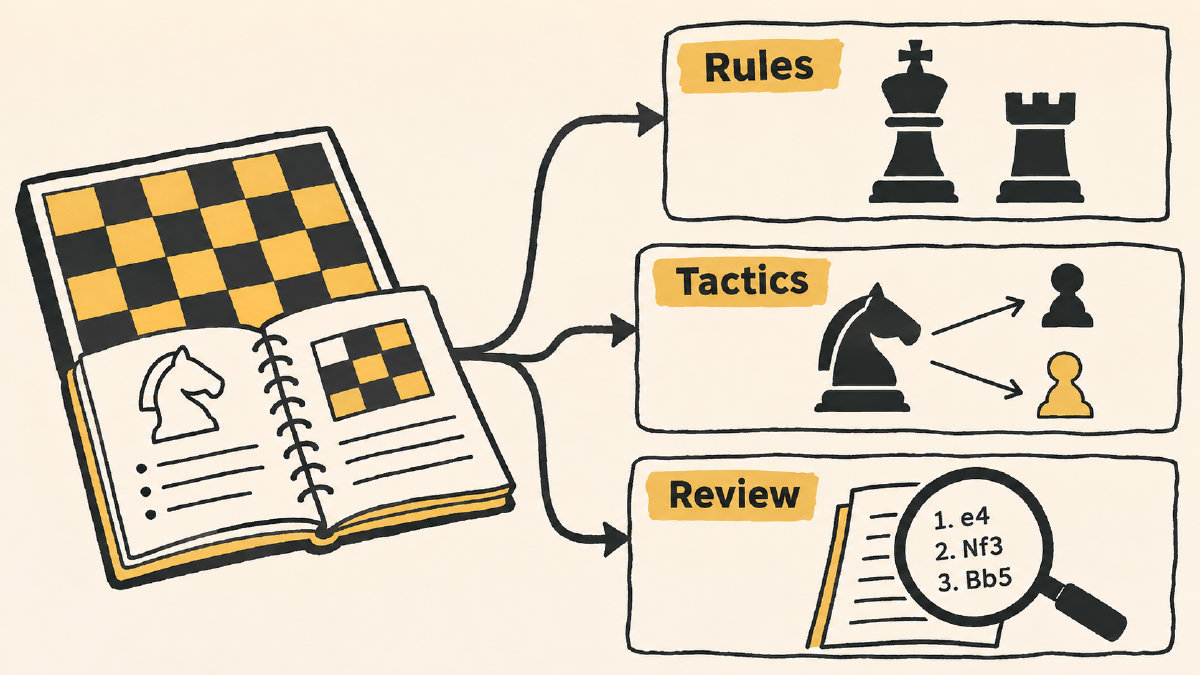
A blunder is a serious error that significantly changes the assessment of the position. The amount by which the position worsens is measured in centipawn loss, where 100 is equal to one pawn. Centipawn loss is simply the decline in engine evaluation.
However, there is more to it. An evaluation loss doesn’t necessarily mean that a pawn was captured. Your position might be worse, or you might have lost a lot of space. All of these situations might produce a pawn-equivalent evaluation loss.
Average centipawn loss is simply the evaluation losses averaged across all the moves played. So an average centipawn loss of 50 equals an average evaluation loss of 0.5 pawns per move. The same number can come about by repeated smaller errors, or from one large blunder. It can be misleading.
Lichess Accuracy
I tend to interpret Lichess accuracy through the lens of changes in the winning chances. From the engine’s point of view, your own move can only preserve your winning chances or reduce them through a mistake. Lichess uses a nonlinear formula to turn that decrease into move accuracy, so a one-percentage-point loss in winning chances isn’t a one-percentage-point drop in accuracy.
On the surface, it might seem like Lichess accuracy is simply the arithmetic average of move accuracy. However, that’s not quite accurate. In complex positions, it’s possible that accuracy might fall. That’s because complex positions contain best moves that are harder to find.
Accuracy may decrease even if the position is correct. In other words, it’s a review context, not a school grade.
Because of the formulas, engines and analysis depths that differ from site to site, there’s no universally accepted calculation for accuracy percentages. Some sites provide accuracy percentages directly, while others offer an interpretation of accuracy.
How to Study Your Own Games
After playing a game, you should import it into a program that analyzes the game and offers suggestions for improving your skills. ChessAnalysis at https://chessanalysis.dev/ has an excellent interface, and you can import a completed game from Chess.com or Lichess, or you can paste the PGN (Portable Game Notation) into the box. (If you need help with PGN, ChessAnalysis has instructions.)
ChessAnalysis also provides free browser-based Stockfish reviews at https://chessanalysis.dev/. You’ll get accuracy, blunders, and the best move as Stockfish reviews every move. (The review tool has no daily limit.)
With the exception of Chess.com, ChessAnalysis does not offer a mobile application. You can, however, access it through your phone’s browser.
The analysis board allows you to input FEN or PGN and study a specific position. You can save the analysis board to review later. ChessAnalysis also includes a variety of study exercises to enhance your understanding of the game. If you want to improve, try to revisit a relevant move and describe what happened in terms of the vocabulary we covered above.
Sources
More in Chess Basics
- How the Queen Chess Piece Moves, Captures and Stays SafeLearn how the queen chess piece moves and captures, what its nine-point value means, and how to review queen-safety mistakes after a game.
- How Fools Checkmate Works and How to Avoid ItUnderstand fools checkmate, usually called Fool's Mate: the two-move sequence, why White cannot escape, and pawn mistakes to review afterward.
- How to Use Chess Piece Points to Count Material and Compare TradesLearn chess piece points, count material after exchanges, and understand why activity, king safety and engine evaluations can outweigh the totals.