Gambit Definition: Why Chess Players Offer Material
Learn the gambit definition in chess, what accepting an offer means, and how to assess material and compensation when reviewing a finished game.
- Chess Terminology
- Material and Compensation
- Post-Game Review
On this page
A gambit is the chess definition of offering material, usually a pawn but sometimes more valuable pieces. But in everyday life, a gambit is also any strategic maneuver or sacrifice intended to gain an advantage, usually by giving up something of value now for future benefit.
The King’s Gambit and Compensation
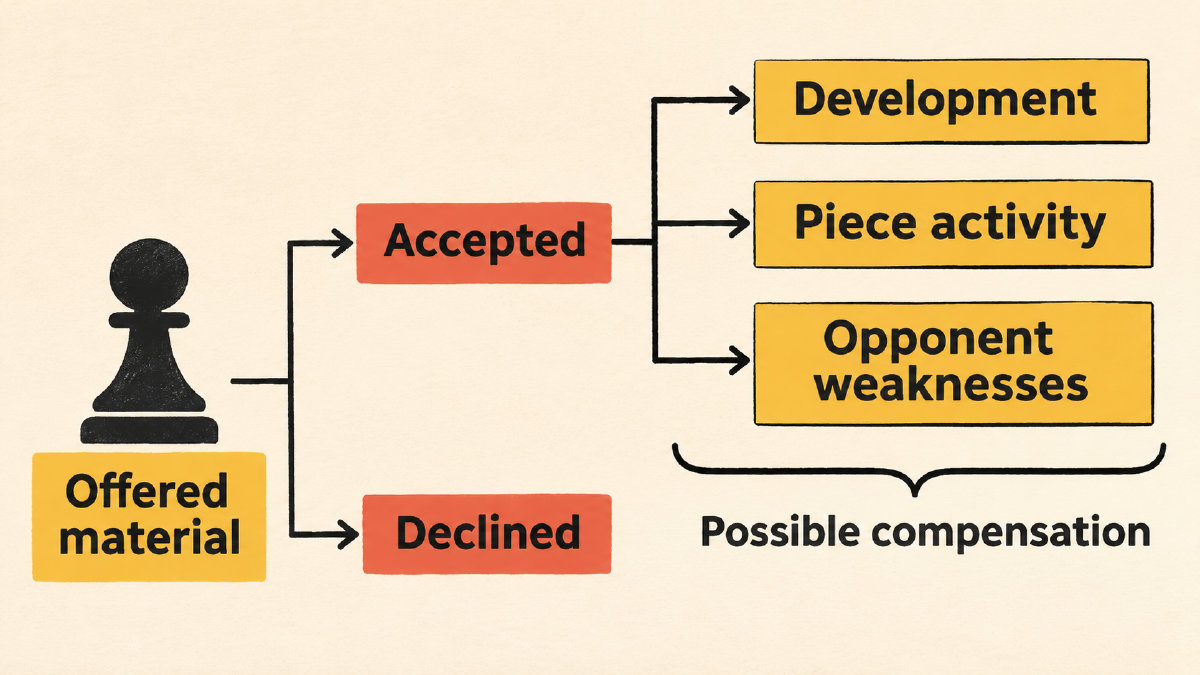
White offers a pawn on f4 in the King’s Gambit (1.e4 e5 2.f4), expecting Black to capture it. If Black does so (2...exf4), then White has offered and lost a pawn. However, if Black ignores the offer (2...Bc5, for example), then no material has been lost, though White might choose to accept the loss of a pawn in order to achieve some other goal.
There are many reasons why White would make a gambit. For example, faster development of pieces and greater space can help White launch a more aggressive attack, while the weakness created in Black’s position will become apparent later. A sound gambit offers compensation for the material invested; an unsound one doesn’t. In general, the gambit label means that White is offering material for compensation, whether or not the material is later recovered.
The Queen’s Gambit and Pawn Recovery
White offers a pawn in the Queen’s Gambit (1.d4 d5 2.c4), intending to control the center. But if Black captures it (2...dxc4), then the c-pawn is gone. Here, the light-squared bishop recovers the pawn (3.e4 e6 4.Bxc4) in this continuation. The line shows that White had more space, and the resulting move sequence gave White a large central space advantage. However, note that the recovery is part of this particular opening sequence, and not guaranteed in every variation. The gambit label doesn’t imply that White should lose the pawn forever, only that they have made a temporary sacrifice to create a better chance for success.
When reviewing a completed game, consider the following questions: What was offered and captured? Did one side develop its pieces more quickly than the other, or did some become more active? Was there more space available to one side or weaknesses created in the opposing position? And finally, did those gains justify the investment beyond the initial capture?
You’re probably familiar with the name of the opening you played. It may be the Italian Game, the Sicilian Defense, or the Ruy Lopez. But what matters most when evaluating a game is how well your sacrifices paid off — even if you lost a pawn, perhaps you gained more than just that!
Sources
More in Chess Basics
- How the Queen Chess Piece Moves, Captures and Stays SafeLearn how the queen chess piece moves and captures, what its nine-point value means, and how to review queen-safety mistakes after a game.
- How Fools Checkmate Works and How to Avoid ItUnderstand fools checkmate, usually called Fool's Mate: the two-move sequence, why White cannot escape, and pawn mistakes to review afterward.
- How to Use Chess Piece Points to Count Material and Compare TradesLearn chess piece points, count material after exchanges, and understand why activity, king safety and engine evaluations can outweigh the totals.