What the Blunder Definition Means in Chess.com Game Review
Understand the blunder definition in Chess.com game review, how it differs from a mistake, and why the label depends on expected points.
- Move Classifications
- Chess.com
On this page
The term “blunder” is one that you’ll hear a lot from players, either as an exclamation of surprise or a description of what they’ve done (or failed to do). The meaning of “blunder” is simple: it means something that was done in a careless or stupid way. It’s the opposite of “a stroke of genius.”
The Blunder Definition in Game Review
In terms of game review, though, there’s a more precise definition.
Blunder: a gross, stupid, or careless mistake; Chess.com Game Review; Classification V2
It should also be noted that the classification of a move as blunder, mistake or inaccuracy can vary between different programs. Inaccuracies are the least severe, followed by mistakes and then blunders. But how exactly does this work?
The Expected Points Model
The answer has to do with how Chess.com classifies a move — its Expected Points Model. A player’s rating and the engine’s evaluation both influence the expected points.
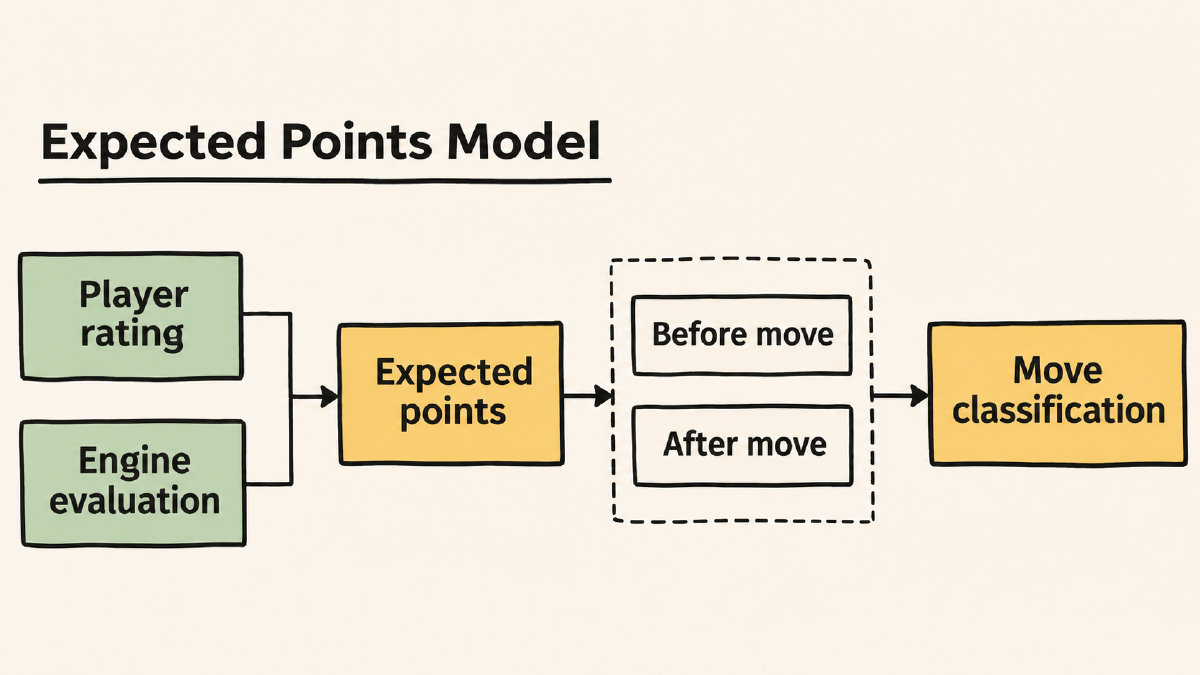
Expected points are calculated so that 1.00 indicates a situation where you will always win; 0.00 indicates where you will always lose; and 0.50 indicates even. You might say that the expected points model takes into account both the engine’s assessment of your position and your likely outcome.
A move’s classification is based on how much the expected points change after the move. If it’s a large drop, it’s a blunder. If it’s smaller, it could be a mistake or an inaccuracy. Here are the published lower and upper limits for each:
Chess.com Classification V2
Inaccuracy: 0.05–0.10 expected-points loss
Mistake: 0.10–0.20 expected-points loss
Blunder: 0.20–1.00 expected-points loss
What a Blunder Classification Means
So if I flag a move in a completed-game review as a blunder, that doesn’t mean that I think that you made a bad move. It means that the difference between before-and-after is such that there’s a substantial reduction in the expected points. There are many ways for this to happen — some that are obvious tactical errors, others that don’t look like they’re all that bad. What it shows, though, is that the computer believes that your chances of winning dropped substantially because of what you did.
Sources
More in Game Review & Analysis
- How to Recognize and Avoid Stalemate in ChessRecognize stalemate in chess, distinguish it from checkmate, and review your completed game's ending to spot how the draw happened.
- How to Choose Great Opening Moves in Chess as a BeginnerChoose great opening moves in chess with 1.e4 or 1.d4, purposeful development and king safety, then review those decisions in completed games.
- How to Recognize Zugzwang in Chess EndgamesRecognize zugzwang with a king-and-pawn example, understand why whose turn it is matters, and learn what to check in completed-game reviews.